
This appeared in the correspondence section1 of Fortean Times 464 (December 2025), relating a story told by the grandmother of the author, Robert Flood:
During the First World War her husband was serving in the Royal Naval Air Service and Nan was living with her parents in Temple Mill Lane, Stratford (her father worked at the GER Works at Stratford). Whenever the Aurora Borealis/Northern Lights were mentioned she always said that during this time there was an aurora display and that people thought it was Zeppelins dropping poison gas. I can see that the greenish colour might trigger the idea of chlorine. I would be interested to know if anyone knows anything about this.
Now, you might think that I’d be such an anyone, given my very particular set of skills, but unfortunately I’m not. I’ve never come across this connection between Zeppelins, aurorae, and poison gas before; nor can I find any evidence of this in the wartime press.
That definitely doesn’t mean this belief did not exist, though it perhaps puts a limit on how widespread it might have been. My guess is that if there was such a belief, it would most likely have dated to either 1915, when ill-considered official advice about how to prepare for chemical warfare on the home front led to a brief vogue for civilian gas masks, though I’ve never seen much evidence that anyone was very worried about this, or else 1917-18, when there were some genuine fears of the possibility, and even the actuality, of poison gas bombs being dropped on London and elsewhere. From my limited research into this question, the revival of fears in the latter period seems to have mainly concerned civil defence workers, though there was at least one case of a coronial inquiry which considered the possibility that a small child had been gassed by a bomb in the East End (and which concluded in the negative). In any case, those had more to do with aeroplane raids than airship ones, and nothing to do with aurorae.
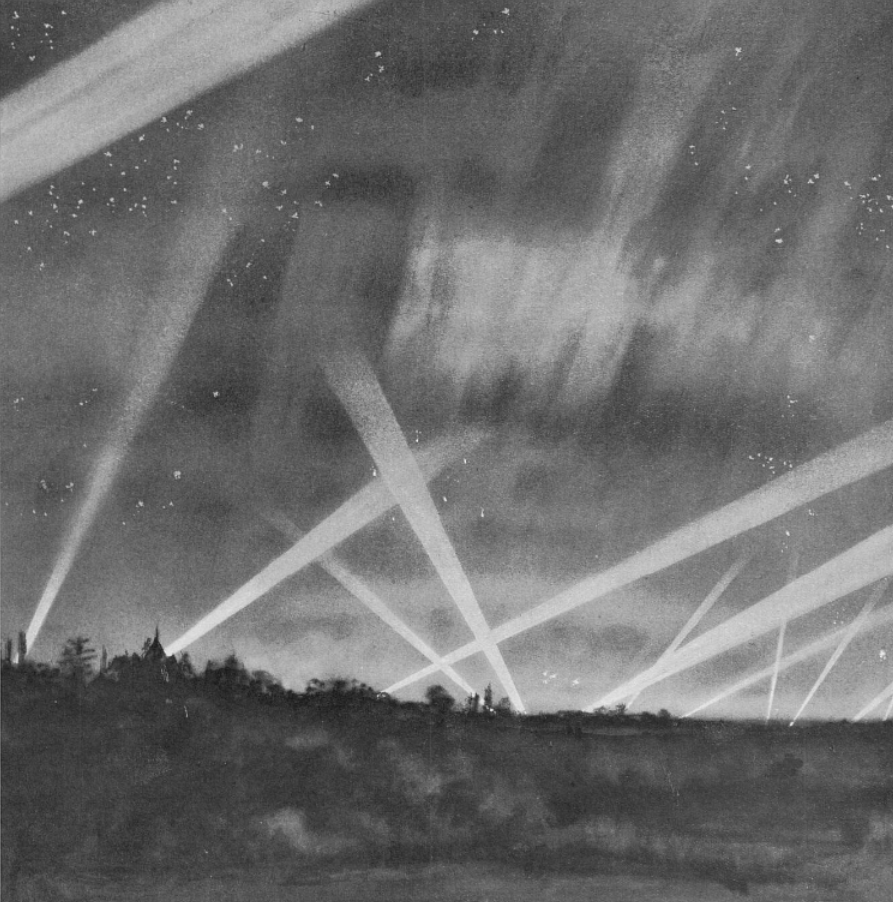
However, at least one Gotha (technically, Giant) raid was associated with an auroral display, that of 7 March 1918, which in fact was sometimes called the ‘Aurora Borealis Raid’ by some newspapers, such as the Sphere (which marked the occasion with the artist’s impression shown above). This raid shows how an unusually striking aurora could readily be incorporated into the spectacle of aerial bombardment:
Last Thursday’s starlight-cum-Northern Lights raid was an unwelcome surprise to Londoners, who had begun to acquire a sensation of absolute safety so long as the moon was below the horizon. Whether the Aurora Borealis display actually took place or was merely a bit of official camouflage I am not in a position to say. Until this explanation came out the general opinion was that the lights came from a series of big fires to the north of London. One of those extraordinarily well-informed people who are always ready to give others the benefit of their vivid imaginations told me that they were a brand-new kind of pink light for guiding our aeroplanes home and added (a pretty touch!) that he had watched our planes gliding down between them!2
So I’m certainly not going to discount the possibility that British people saw the aurora borealis and thought it was poison gas!
Image source: Sphere, 16 March 1918, 229.
 This work is licensed under a Creative Commons Attribution-NonCommercial-NoDerivatives 4.0 International License.
Permissions beyond the scope of this license may be available at http://airminded.org/copyright/.
This work is licensed under a Creative Commons Attribution-NonCommercial-NoDerivatives 4.0 International License.
Permissions beyond the scope of this license may be available at http://airminded.org/copyright/.