

One factlet I’ve enjoyed dropping on the heads of students is the origin of the word ‘blockbuster’. Now it is widely understood to mean a hugely successful movie (as well as a once-highly successful video rental chain — remember those?). It has even been claimed that this is the original sense of the word: supposedly, in the 1920s a blockbuster was ‘a movie whose long line of customers could not be contained on a single city block’. But with Google Books and online newspaper archives it’s easy to disprove this etymology: blockbuster does not appear before 1942 and then it referred to a bomb which was so big it could destroy a whole city block.
The earliest press references I can find are all American. The earliest I’ve found is from an unsigned United Press report published on 29 July 1942:
The aerial second front against the Germans already is striking telling blows, including another 600-plane RAF raid with block-buster bombs on the Nazi submarine base and port at Hamburg last night in addition to attacks that dumped 1,200 tons of explosive on Hamburg and Duisburg over the weekend.1
Some further specifics follow later in the same article:
The RAF’s latest attack on Hamburg, in which Britain’s 4,000-pound ‘block buster’ bombs and thousands of incendiaries rekindled the still smouldering ruins of targets wrecked in Sunday night’s 600-plane raid, cost the British 32 planes.2
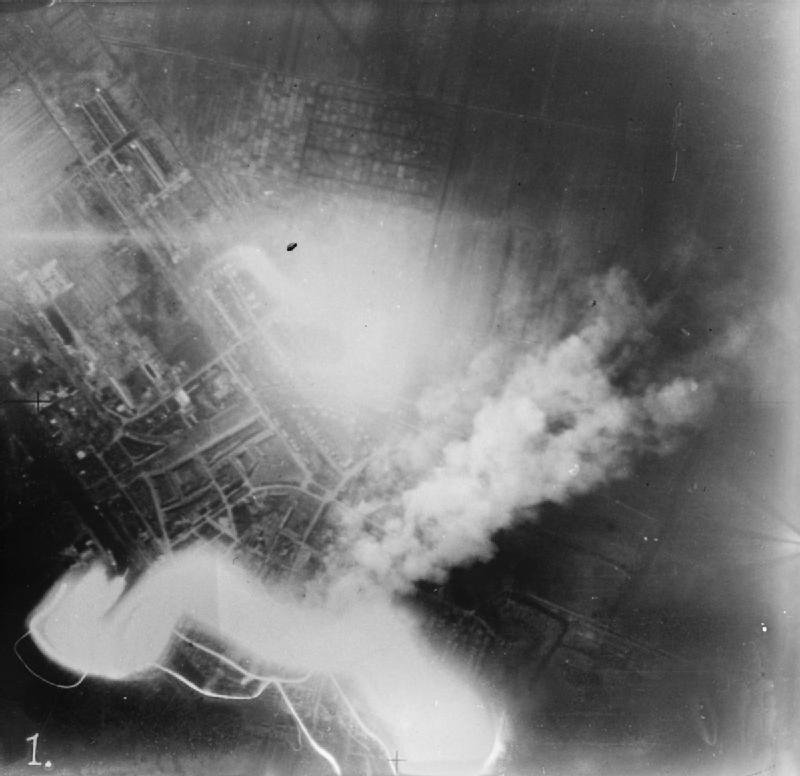
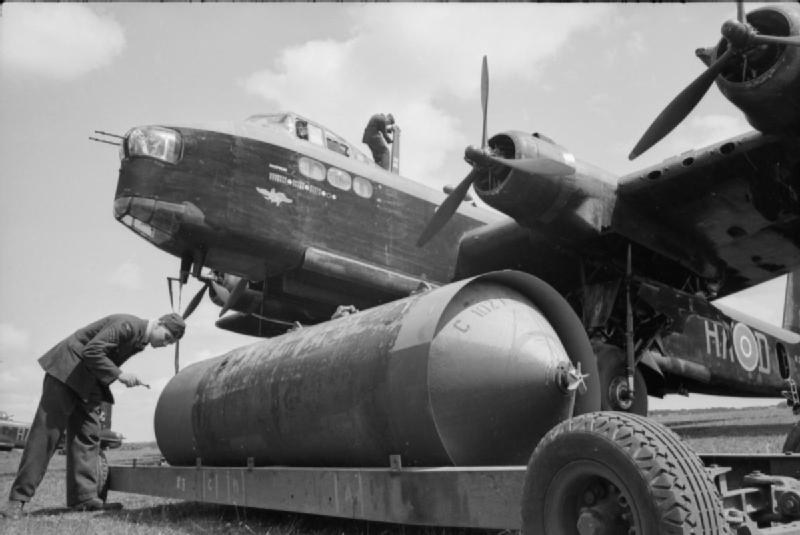
This is a reference to the 4000lb HC (High Capacity, meaning it was about 75% Amatol rather than 50%) blast bomb, known in RAF parlance as a ‘cookie’ (how this term originated is another question!), which debuted on the night of 31 March 1941 in a raid on Emden. (The bomb and the raid are shown in the above photos.) Despite the press dubbing it a blockbuster, its main purpose was to knock off roofs and shatter windows, creating draughts and hence optimal conditions for the accompanying incendiaries. At some point in 1942 (I’ve found three different dates) the 8000lb HC bomb (sometimes called the ‘super cookie’) was introduced, though the 4000lb was found to be more effective for the purpose of burning out cities.
Curiously, ‘blockbuster’ doesn’t appear in the British press until January 1943 (and even then the next one isn’t until March). That was in the Manchester Guardian, quoting Edward R. Stettinius, the head of the American Lend-Lease programme:
Quantities of some additional military supplies that have been or are being furnished by the British to our troops as reciprocal aid by Britain include 15,000 bombs, from 250lb. incendiaries to one-ton ‘blockbusters’ […]3
(One ton is only 2000lb, so he’s presumably actually talking about the cookie’s little sibling, but no matter.) The reason I find this six month lag to be curious is that the Australian press picked up ‘blockbuster’ much more quickly: September 1942, only 2 months after the first American example quoted above. The first Australian use I’ve found is from September 1942 actually ‘block-busting’, and again the source is American, Colonel Knerr, formerly Chief of Staff of the USAAF (though the Australian Associated Press journalist is paraphrasing at this point and it may be their choice of word):
The Britons like block-busting; Americans prefer to attack specific targets with precision instruments. ‘What could be better? Our planes come over in daylight, and knock down what the British missed at night.’4
Admittedly blockbusters or blockbusting didn’t spread like wildfire after that point, as the next mention I can find is in December; but that’s the same pattern as in Britain and Australia had a four-month head start. Shortly it became quite common in all three countries (and presumably elsewhere in the English-speaking world).
One reason why ‘blockbuster’ might not have appealed to British readers (or writers, rather), at least initially, is that (as David Underdown and JDK both pointed out to me) the idea of a city block doesn’t make much sense in Britain, because most urban areas evolved over centuries and millennia, rather than being designed as was generally the case in the United States, at least archetypically — compare maps of London and New York and you’ll see what I mean. The term ‘block’ in this sense originated in the United States, and while it does seem to have been known in Britain by this time it probably wouldn’t have meant much to most people. Conversely, the term was used in Australia, though in slightly differently: here it means what Americans would call a ‘lot’, an individual parcel of land, so smaller than an American block. But the other sense seems to have been understood too, perhaps because our towns and cities also tend towards the rectilinear ideal (see the Hoddle Grid, for example).
But it occurs to me that Britons might have understood ‘blockbuster’ to mean, not a city block, but a block of flats (apartments in American), increasingly popular urban developments in interwar Britain. In fact, as JDK also pointed out destroying a block of flats was probably a more realistic ambition for a cookie than a whole city block. Which brings me to something resembling an interesting point: perhaps the trouble with ‘blockbuster’ was not that it was too difficult to understand in Britain, but rather that it was too easy? Unlike ‘cookie’, for example, it’s not at all a euphemistic term: it comes right out and says that we are destroying cities block by block or — even worse — home by home? As we know, dehousing was indeed the policy of Bomber Command from 1942; but we also know that nobody was allowed to say so in public. So, and this is purely speculation on my part, I wonder if the delay in adopting such an eminently useful and descriptive colloquialism was due to censorship, or at least official discouragement? If so, the question would then be why the term was eventually allowed.
One final point. Some reports claimed that ‘blockbuster’ was a German term (presumably transliterated): ‘BLOCK BUSTERS, NAZIS CALL THEM — AND THEY KNOW WHY!’, for example.5 More common is the idea that Germans called blockbusters ‘”block bombs,” because the explosion demolishes an entire block of buildings’.6 In fact, ‘block bomb’ predates ‘blockbuster’ by some months. I can’t find any evidence that Germans used either term, even transliterated; the equivalent German terms seems to be ‘große Bombe‘ (big bomb). But maybe ‘block bomb’ was an intermediate stage on the way to ‘blockbuster’.
Image sources: Imperial War Museum C 1888, CH 17887.
 This work is licensed under a Creative Commons Attribution-NonCommercial-NoDerivatives 4.0 International License.
Permissions beyond the scope of this license may be available at http://airminded.org/copyright/.
This work is licensed under a Creative Commons Attribution-NonCommercial-NoDerivatives 4.0 International License.
Permissions beyond the scope of this license may be available at http://airminded.org/copyright/.
- Oxnard Press-Courier, 29 July 1942, 1. [↩]
- Ibid., 6. [↩]
- Manchester Guardian, 25 January 1943, 5. [↩]
- Cairns Post, 19 September 1942, 5, and at least two other newspapers on the same date. [↩]
- Mail (Adelaide), 19 December 1942, 6. [↩]
- Sydney Morning Herald, 28 March 1942, 9. [↩]

I wonder at that photo of the “blockbuster” in front of the Stirling. There’s no way I know of that a thing that size could be loaded on that plane, is there?
Interesting post, Brett, and hard to tie down original meanings! I should add that the issue with ‘city blocks’ in London was made stark when I worked there in the 1980s: American tourists would ask how many blocks it was from ‘here to their destination’, and were incredulous when told that the city didn’t have blocks – that it was a meaningless measure (they were often holding non-block containing London maps at the time). Naturally, they couldn’t believe otherwise that we must therefore be being needlessly awkward…
Heather’s right, due to the two structural beams in the Short Stirling’s bomb-bay, it could not carry a 4,000 cookie or any large diameter bomb, without leaving off the doors, which I don’t think they ever did.
As I said last night, I’d ask my contacts who deal with official British aviation documents. No definite response, but a variant meaning (off the cuff, admittedly) in from Steve: “Cookie being a 4000lb device and blockbuster 8000lb. Both terms, I would have said, were non official (unlike Tallboy and Grand Slam) but maybe they had some official sanction? I would expect to see referenced to them in combat reports…”
Oh, and another tangent, there was ‘Block buster’ in 1973 from that ever-so-nice band ‘The Sweet’.
More data wanted!
I think that the “blockbuster” evolves out of the “aerial mine.” During the early German influence mining campaigns, parachute mines sometimes drifted over land. The weapons were fused to detonate on hard landing, and since they contained a very large amount of explosives, did extensive damage. This did not go unnoticed, and according to the sources that I can’t remember, by the height of the Blitz, the Germans (and British?) were dropping mines over cities deliberately.
The departure with the HC bomb was that it was the first weapon that could be dropped without a parachute, making it much more accurate.
Heather:
Well spotted, I didn’t even think about that! You’re right, even though Stirlings could carry a generous payload a cookie simply wouldn’t physically fit (I think the dividers JDK mentions can just be seen in the photo; a somewhat clearer shot is here). So I wonder what was going on there? Was it propaganda aimed at deceiving Germans by conveying the impression that the Stirling could actually carry a cookie and so was more threatening that it actually was? Or just the photographer on the day deciding that the bombs being loaded onto their subject just weren’t impressive enough and borrowing something bigger?
JDK:
Thanks for enriching my life with that musical reference of which I was previously unaware!
Erik:
That seems plausible, the HC bomb specifications were issued in September 1940 at the start of the Blitz (though it seems based on discussions going back to July). On the German side, ‘Minenbombe’ was a synonym for ‘große Bombe’. But I’m not sure how this gets us to the word ‘blockbuster’, as opposed to the actual thing itself?
What about the ‘buster’ part? Is that an Americanism?
Yes indeed, according to the OED. A quick scan of BNA shows that in 1940-1 it was most often used in ‘racket-buster’, always in the American context. The OED also has an entry for military ‘-busters’, but some of these may have been inspired by ‘blockbuster’ (including one I entirely forgot — ‘Dam Busters’!) The earliest they give is ‘balloon buster’ but the cite is American and another quick search doesn’t turn up a British use. ‘Tank buster’ is another Americanism (the Airocobra seems to have been the first one) dating from 1941, so that maybe influenced ‘blockbuster’.
However, just to confuse things, a British railway gun which went into operation in 1918 was called ‘Boche Buster’…
Good question. Another British English ‘buster’ of the Great War was ‘balloon-buster/-busting’ for attacking observation balloons and I’m pretty sure it’s not an anachronistic term and pre-dates US involvement.
Eric said: ‘I think that the “blockbuster” evolves out of the “aerial mine.” During the early German influence mining campaigns, parachute mines sometimes drifted over land. The weapons were fused to detonate on hard landing, and since they contained a very large amount of explosives, did extensive damage. This did not go unnoticed, and according to the sources that I can’t remember, by the height of the Blitz, the Germans (and British?) were dropping mines over cities deliberately.’
The books ‘Softly Tread The Brave’ and a children’s version ’17 Seconds’ by Ivan Southall document the careers of four Australians in the Rendering Mines Safe (RMS) unit of the RN during the Blitz and beyond. Certainly the Germans were dropping booby-trapped and delayed-action sea mines deliberately on British cities (a significant number were definitely NOT fused to go off on landing) and the story of Syme, Mould, Reid & Kessack (‘Red’ Kessack was killed defusing a mine) are one of the most incredible accounts of cold-blooded courage I’ve ever read. (Both Syme and Mould were awarded well-earned George Crosses, and there is a German mine on show at the AWM documenting their story.)
http://adb.anu.edu.au/biography/mould-john-stuart-11187
http://adb.anu.edu.au/biography/syme-hugh-randall-11815
I’d agree the un-aerodynamic and HC nature of the German mines adapted with booby traps and used over land were used by the Germans in the way that the RAF later used cookies; however there’s no mention of the German weapons being considered ‘block-busters’ in name by Southall, nor have I read of any use of British mines (when used appropriately they were ‘Gardening’ ops in Bomber Command parlance) to attack German land targets. Correction welcome.
‘The departure with the HC bomb was that it was the first weapon that could be dropped without a parachute, making it much more accurate.
Obviously, we’ve lost something in the translation here! Previous to the parachute mines, most bombs were dropped without parachutes; and parachute mines were indeed not accurate. However I’m not sure the HC cookie bombs were directly inspired by the German mines, though I’d agree the effect of German mines’ blast may have been a key ingredient in the development of the cookies to open buildings for incendiaries.
According to some references, the 4,000 lb cookie could be dropped with a nose and tail case ‘relatively accurately’, but most photos show them in use without – so less accurate than an aerodynamic bomb, although not likely to drift as the parachute mines would. (I suspect that the aerodynamic casing was found to offer little benefit in accuracy for extra cost and inconvenience, and was quickly abandoned.)
I had a look in the official history (Webster and Frankland) but it’s not a good source for bomb development; I couldn’t find any mention of the German parachute mines inspiring the British cookies, anyway. The Blitz experience did inform the dehousing strategy, however, at least generally.
That’s interesting about ‘balloon buster’, I’d forgotten that one. But digging in the newspapers and Google Books, I can’t find much contemporary evidence to support a WWI origin. It could have been used in the services, but not found its way into civilian use until after the war. I did find a early war poem entitled ‘Balloon busters’, which appeared in the Dover Express, 15 February 1915, 5:
It’s not clear if the title is Dunn’s or the newspaper’s, but either way it doesn’t refer to pilots shooting down observation balloons over the Western Front but AA gunners shooting down Zeppelins over Britain. (So even before the first Zeppelin raids on Britain they were being cast as cowardly weapons!) More importantly, that’s the only British press use of the term I can find during the First World War. Ditto for Australian and American newspapers; ditto for Google Books. The term seems to have passed into wider usage after 1928, with the publication that year of Norman S. Hall, The Balloon Buster: Frank Luke of Arizona (I did find an ambiguous use in a baseball report in the Syracuse Herald, 23 April 1922, 14: ‘McInnis is hitting like a balloon buster’) and it really seems mostly American than British (it’s not common enough to show up in Google Books’ British English corpus, and the earliest British press example I’ve found after the poem above is in 1939. The first use in Flight is only from 1958, for example. As I say, this doesn’t quite rule out a WWI origin as military slang; and Gunner Dunn’s poem is very intriguing in this regard!
Here’s a relatively early description of blockbusters which doesn’t call them that, instead referring to them as ‘high-duty bombs’, but does mention the supposed German term ‘block bombs’ — J. M. Spaight, Volcano Island (London: Geoffrey Bles, 1943), 69-70:
Volcano Island appears to have been written in September-October 1942, which fits with the post: ‘blockbuster’ wasn’t used in the British press until early 1943, but ‘block bomb’, as the German term, was fairly common. ‘High-duty bomb’, on the other hand, seems quite rare; it appears in an April 1942 story (published in Australia and the US, not sure about Britain) but nowhere else. It may have been a mistake for ‘High Capacity bomb’, the official term.
Hello all- The plane was not a Stirling but a Wellington Mk 2 no. R 1513
I know because my father piloted the first of the two planes that were used on the mission at Emden. His logbook states “I flew the a/c to mark target with incendiaries and following Mk 2 dropped 4000lb blockbuster. The first to be dropped during the war”
Thanks, Ian. There may be some confusion here — nobody’s claiming that the Stirling carried any blockbusters, except (by implication) the photo of a blockbuster I chose to illustrate the post, which appears to be a PR officer’s arrangement. It would be interesting if the comments in your father’s logbook could be dated, but it does sound like it might have been a later addition.
Pingback: 12 Interesting Word Origin Stories - Hongkiat
Pingback: 12 English Words With Interesting Origins - Hongkiat
Pingback: 12 English Words With Interesting Origins – timebdnews
Pingback: 12 English Phrases With Attention-grabbing Origins - News.TKT
Pingback: 12 English Words With Interesting Origins – Amrit Sparsha
Pingback: 12 English Words With Interesting Origins – Mass Blog
Pingback: 12 English Words With Interesting Origins -
Pingback: 12 English Words With Interesting Origins - Get Web Hosting Coupons
Pingback: 12 English Words With Interesting Origins - Web Host Mama
Pingback: 12?????????? - ???
Pingback: 12 engelska ord med intressanta ursprung - Tekniska Nyheter, Recensioner Och Tips!