

After the AHA, I stayed in Adelaide for a few days to see the sights. I have a bit of a thing for maritime museums, so the South Australian Maritime Museum at Port Adelaide was an obvious choice. It became even more obvious when I discovered that the National Railway Museum and the South Australian Aviation Museum were both within easy walking distance of the Maritime Museum!
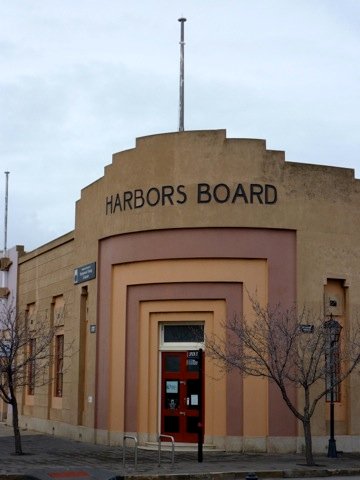
Port Adelaide itself is a very pretty area, with many interesting buildings dating back to the colonial era. This one is a bit more modern, in the interwar art deco style. But it’s the way ‘harbors’ is spelt which caught my attention here: not in the Australian way (-our) but the American way (-or). That’s because (to my horror as a staunch nationalist when it comes to spelling) for a time early in the late nineteenth and early twentieth centuries it was not uncommon to follow the American example in this area. Which is presumably why we have an Australian Labor Party when in every other context we would write ‘labour’.

Speaking of labour, this is the Workers’ Memorial, which was unveiled in 1921 (I suspect the scarf and hat are of more recent origin). It makes a nice change from the war memorials which are far more common from this period (don’t worry, there will be some of those in a later post). But why a workers’ memorial, and why at that point in time? It in fact had its origins in the First World War: the committee to raise funds for it formed in January 1917, and the foundation was laid a few days before the Armistice in November 1918. It
was erected, according to the inscription, ‘to perpetuate the memory of deceased Labor Workers’ (there’s that spelling again). Given the timing, I wonder if it was a product of the bitter conflict over the conscription issue between the trade unions and the Labor party on the one hand, and Billy Hughes and the Nationalists on the other? That is the way Humphrey McQueen frames it, but an interesting selection of historical documents about the memorial put together by a modern-day trade union doesn’t seem to provide much direct evidence for this theory (linked from here). But perhaps that’s because it was either too recent to say such things or too long ago to remember.
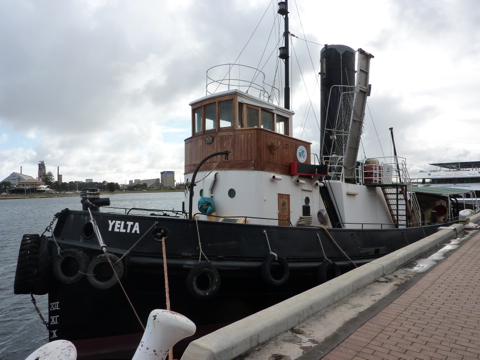
This sturdy vessel is the Yelta, the last steam tug to operate in South Australia: it was operational between 1949 and 1976. It’s still in working condition, too. Part of the Maritime Museum’s collection.
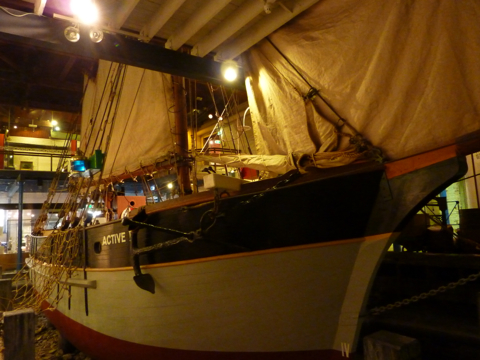
The Museum doesn’t have many real ships; it does have this fake ship, the Active II, a replica of a ketch which worked South Australian waters for more than three-quarters of a century from the 1870s. It may not have the history of its original but I’m sure it’s just as fun to clamber over.
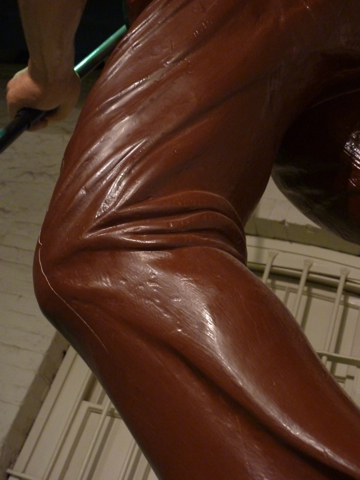
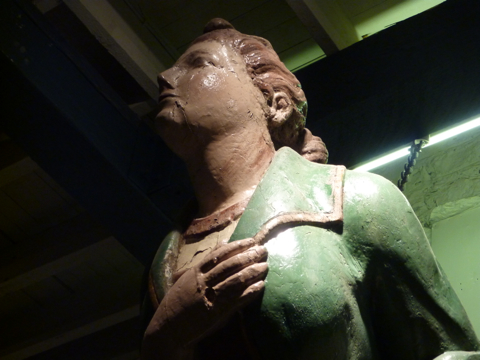
There’s a wonderful collection of ship’s figureheads along one of the walls, spanning two levels. The one at the top of the post is from the Glen Park, a barque built in Glasgow in 1897. It had only a brief career, running aground in the Spencer Gulf in 1901. The photo above shows part of the figurehead — the knee to be exact — from the Ville de Bordeaux, a French whaler built in 1836 which later came to Australia where it served as a smuggler, a lightship, and a coal hulk. The amount of detail in the folds is remarkable; a huge amount of pride and care went into these objects.
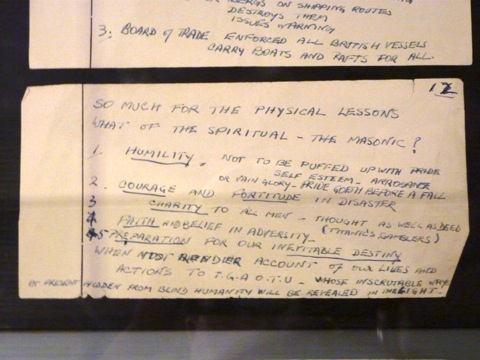
There was an unexpected but excellent exhibition on the Titanic. One of the most interesting parts of this for me were E. D. A. Bagot’s lecture notes. Bagot was a wireless officer on the Olympic when her sister ship struck an iceberg and sank. He was born in Adelaide and returned there after the war, where he became involved in political activism (he was against both communism and fascism, for example). He seems to have dined out regularly on his Titanic connection, but he also used it to put forward his worldview. This card draws out the moral implications of the disaster:
SO MUCH FOR THE PHYSICAL LESSONS
WHAT OF THE SPIRITUAL – THE MASONIC?
1. HUMILITY NOT TO BE PUFFED UP WITH PRIDE
SELF ESTEEM ARROGANCE
2. COURAGE AND FORTITUDE IN DISASTER
3. CHARITY TO ALL MEN – THOUGHT AS WELL AS DEED
(TITANIC’S GAMBLERS)
4. FAITH AND BELIEF IN ADVERSITY
5. PREPARATION FOR OUR INEVITABLE DESTINY
WHEN MUST RENDER ACCOUNT of our LIVES AND
ACTIONS TO T.G.A.O.T.U. – WHOSE INSCRUTABLE WAYS
AT PRESENT HIDDEN FROM BLIND HUMANITY WILL BE REVEALED IN THE LIGHT!
I’m not sure when he wrote this, but another set of cards is evidently from the early 1960s as one intriguingly says ’50 years / FMy [?] – TITANIC – ANZAC / MYSTERY’.
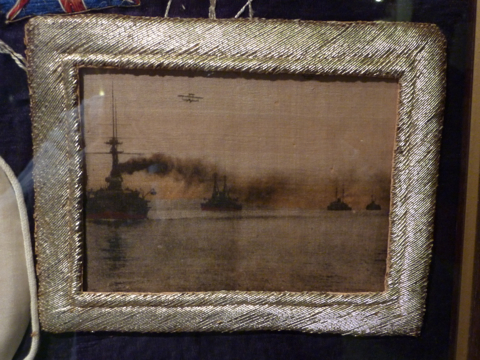
A detail of an embroidered silk memento of Australia’s naval contribution to the First World War dated c. 1918, according to the caption; though looking at it again I can’t see anything specifically Australian about it. I wonder if it’s from earlier in the war than 1918 — that aeroplane looks decidedly primitive, and it’s not the only one.
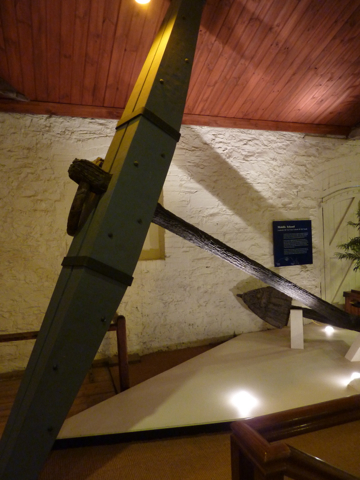
Obligatory anchor shot. This particular anchor belonged to HMS Investigator, the ship Matthew Flinders used in the first circumnavigation of Australia in 1802-3. It had to be cast loose when winds threatened to drive the ship onto the shore at Middle Island in the Great Australian Bight. It took 170 years before it could be brought to the surface again.
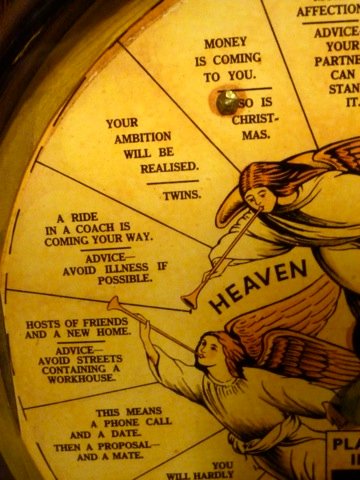
Some of the possible outcomes from a coin-operated fortune-telling machine. Unfortunately I don’t seem to have photographed the caption, but it is presumably from a seaside amusement arcade, maybe Federation period?
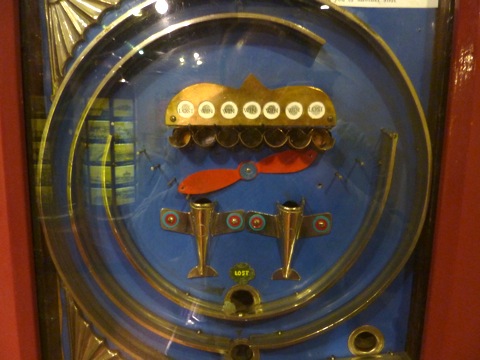
An early pinball-style game, with a very airminded theme. Again I’m lacking context here. A sign on it says it costs 20c, which (if it’s Australian) would suggest a post-1966 date. But surely the machine itself is older than that; I’d guess interwar from the stylised aeroplanes.
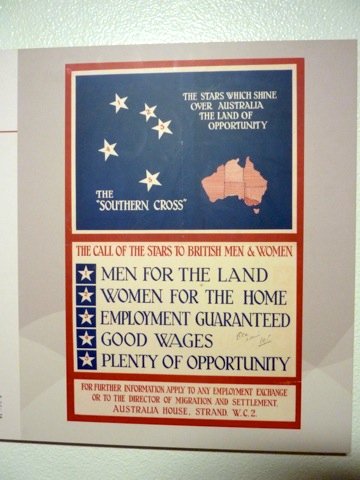
This 1928 poster was designed to convince Britons to emigrate to Australia, ‘THE LAND OF OPPORTUNITY’. The stars of the Southern Cross are numbered one to five and apparently ‘CALL’ to ‘BRITISH MEN AND WOMEN’ to come here for a new life (but not too new):
1. MEN FOR THE LAND
2. WOMEN FOR THE HOME
3. EMPLOYMENT GUARANTEED
4. GOOD WAGES
5. PLENTY OF OPPORTUNITY
I’m not sure how far that employment guarantee would have been honoured, given that the Depression started the following year. But if you’re taking life advice from astronomical objects you really have no basis for complaint.
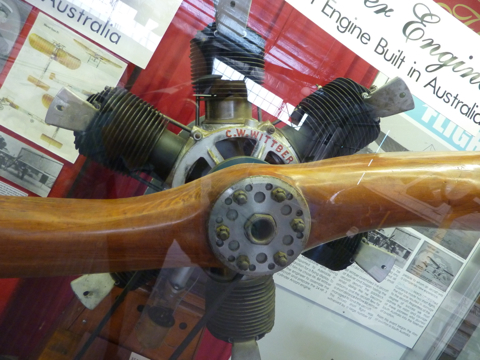
On to the Aviation Museum. It wouldn’t be an aviation museum without a contentious claim about some first or other. In this case, the first is who was the first person to fly in Australia, and the answer given is Bill Wittber. On 13 March 1910 he hopped a Blériot XI for a distance of 50 yards near Bolivar, South Australia. That beat Houdini to the punch by five days, but a hop isn’t the same as controlled flight and it doesn’t seem to have been thought of as a flight at the time (it was described the following day as an ‘unexpected flutter’ by a journalist who witnessed it).
The Blériot crashed the following week and never flew. Wittber rescued its engine for an aeroplane he built himself and began trials in 1914; but found it inadequate so had to construct a more powerful engine, a 55hp Anzani which is shown above and claimed here to be the first constructed in Australia. According to the text provided by the museum, Wittber’s new aeroplane was making successful flights by mid-1915 ‘when the Army stepped in and banned any further attempts at civilian flying’. I don’t know about that. A Victorian aviator named Basil Watson seemed to have been making public demonstration flights quite freely in the middle years of the war before being killed in a crash in 1917. Perhaps the problem was Wittber’s German ancestry: Bill was short for Wilhelm. But I digress…
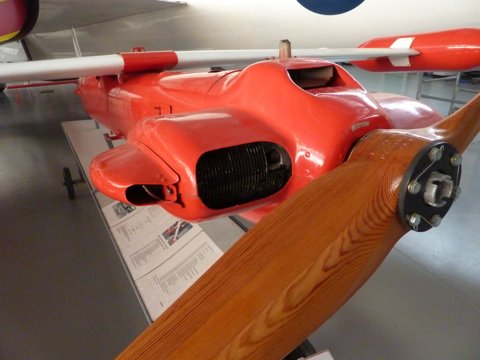
A Northrop KD2-5 Shelduck target drone, according to the placard. The internet does not appear to know about this model, so perhaps it’s a KD2R5? The name Shelduck seems to be associated with the designation MQM-36. Or maybe it’s just a rare variant as it was known by a variety of names throughout its career, which spanned from the late 1940s to the 1970s.
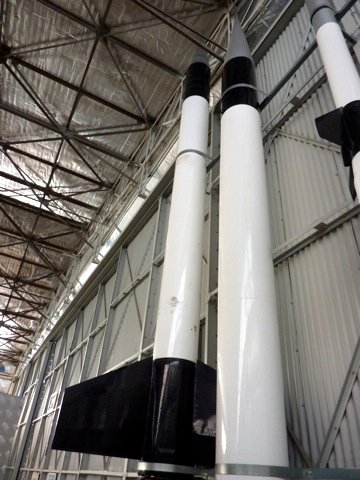
Two sounding rockets. The one on the right is a British Skylark, a single-stage Raven to be precise. In the 1960s and 1970s, hundreds of these were launched from Woomera in the South Australian interior, mainly for meteorological and astronomical research. I’m not really sure about the one on the left. I may be missing the most significant part in this photo, since the placard describes it as an Australian Lupus 1A boost motor. But then what’s the upper stage? I think it’s a Musca, with the Lupus+Musca assembly being known as a Kangaroo. Between 1968 and 1976, more than thirty of these were launched from Woomera and from Gan, an atoll in the Maldives.
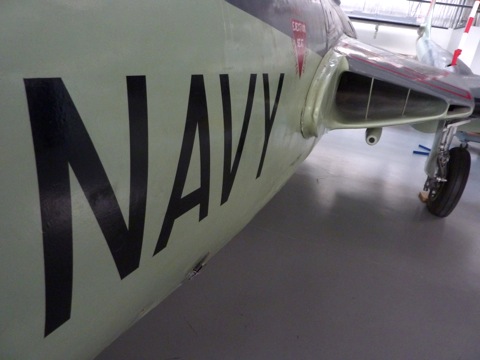
An aspect of a de Havilland Sea Venom. Sea Venoms were flown by the Royal Australian Navy off the aircraft carrier HMAS Melbourne between 1956 and 1967. Apparently at the time they came into service they were the only all-weather, radar-equipped jets in the Southern Hemisphere, which is perhaps less impressive when you consider that we haven’t actually been at war with anybody in the Southern Hemisphere since the Boer War.
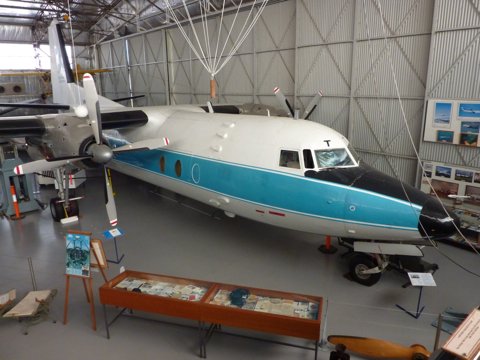
I originally had a lovely photo of an ex-RAAF Dakota here. But then I realised that I had to put in this one of a Fokker Friendship instead, the aircraft of which it is truly said ‘Sorry ocker, the Fokker’s chocker’. Actually, I didn’t realise that it was actually possible to walk through the passenger cabin — I could have seen just how chocker the Fokker actually was. (Not very, I suspect.)
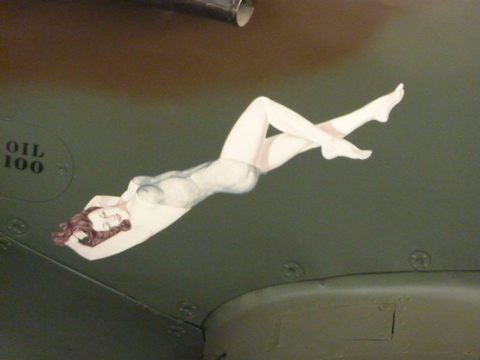
The nose art on a Mark Vc Spitfire, restored from a 79 Squadron aircraft wrecked in a landing accident in 1943. I mean, you’ve all seen Spitfires before, right? So I don’t need to show you a photo of that. The original artwork was copied from a 1943 Esquire calendar by Alberto Vargos; August, to be precise.

I was intrigued to learn of the 1936 Parafield air pageant, part of the celebrations marking the centenary of South Australia’s foundation. While it had an ostensibly civilian character — it was organised by the Royal Aero Club of South Australia and coincided with a Brisbane-Adelaide air race and an aerial derby (Nancy Bird came third) — military aviation was a major drawcard, judging by a contemporary press report:
It was South Australia’s most impressive aerial display. The 12 RAAF Hawker Demon war planes held the pride of place for excitement their aerobatics and other manoeuvres, particularly the diving and bombing, thrilled the onlookers.
There was even a mini-Hendon display:
Next eight Air Force machines came over Parafield at such a height that they were no more than specks. Suddenly they began to grow in size, tearing down out of the blue at a pace which, it seemed, must dash them to the ground. But they straightened out close to the ground, and, as they passed, a houselike structure in the centre of the drome flew to pieces with a bang and a cloud of smoke. While the flight commander was giving orders by radio-telephone, the fighter-bombers climbed to 4,000 ft. and then dived towards the drome at 300 m.p.h. They came with motors roaring like thunder, and struts and wires screaming like fiends. Down and down they fell, dropping like plummets, but each time the pilot picked np his machine close to the ground and snarled upwards in an almost vertical climb.
Nor was this all:
But even this exhibition was eclipsed by the converging bombing by ‘A’ flight of the squadron, and the later squadron dive bombing.
And even civilian pilots played at war:
Other features of the afternoon included an attack on an ‘armored car’ by three Aero Club planes. While the car’s machine guns chattered defensively the aeroplanes dropped dummy bombs.

A certificate issued by the Royal Aero Club of the United Kingdom allowing Captain G. Dawes of Fort Burgoyne, Dover, to participate in competitive flying for the year 1912.
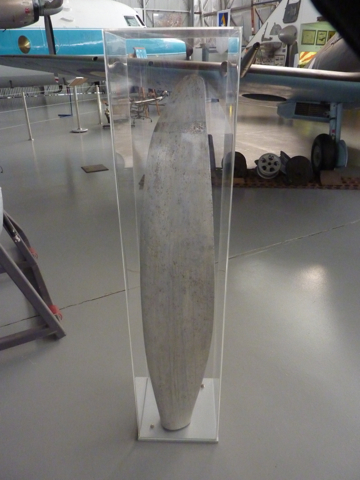
A propellor from a Japanese Mitsubishi G4M shot down over Bougainville by American fighters on 18 April 1943. The significance is that Admiral Yamamoto, architect of the attack on Pearl Harbor, was a passenger on the bomber. US naval intelligence decrypted radio messages containing his itinerary and President Roosevelt ordered that he be intercepted in what was effectively an assassination. I wasn’t sure what to make of this artefact. It could be considered a war trophy of a sort, but there’s no gloating in the interpretative material provided by the museum, which is surprisingly placed under the heading ‘THOSE WHO SERVED’. Interesting.

Thence to the third and final transport museum of the day, this time involving trains. (This is a replica of the old train departures board at Adelaide Station.)

This was by far the best-patronised of the three, even though it was also the most expensive to enter. That may owe something to the fact that it has working trains (on three different gauges), which you can take a ride on for a small charge.
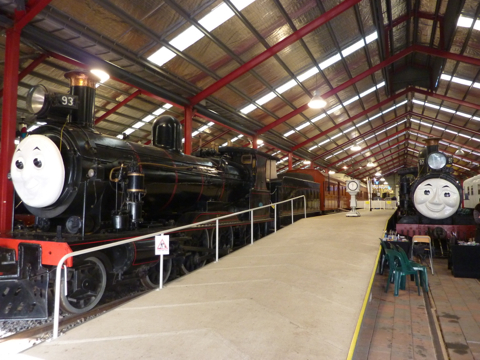
Though might also have been the fact that it was Thomas the Tank Engine day — there were hordes of small children there (not shown) and they lapped it all up, even when I attempted to point out to them that the faces of Thomas and friends were simply hung on the front of the locomotives with a bit of wire.1

Luckily not everything was Thomasified! This P-class pulled freight and passengers on the Port Adelaide line from 1893. Now it’s permanently on its way to the trots.

The observant reader will have noticed that this is a car, not a train. In 1941 the Army took a Chevrolet and converted it for rail use; it was used until 1943 to inspect POW work camps along the Trans-Australian Railway. Afterwards it passed into the hands of the Commonwealth Railways where it was used for track inspection. It has its own little turntable underneath to enable it to reverse direction!

Peronne was a shunter at the BHP smelters at Port Pirie. Now it pulls passengers along a short stretch of track.
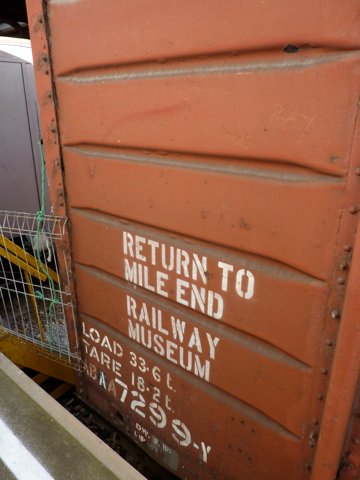
I think this is like those signs on supermarket trolleys. Mile End Railway Museum was the current museum’s predecessor.
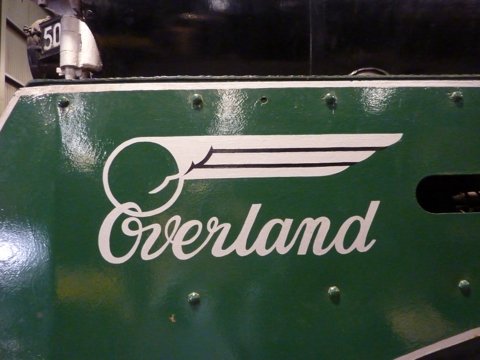
From 1926, the Overland was, and still is, the name given to the overnight passenger service from Melbourne to Adelaide. It was relatively luxurious, with Pullman dining cars imported from the US. I’d like to take the Overland one day but this time I flew.
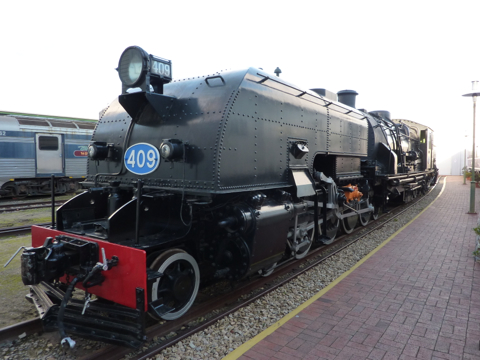
One of the very last steam locomotives to work in South Australian, a French-built oil-burner (though it could be converted to coal) which arrived in 1953. The humble P-class above was in service for six decades; this magnificent beast was retired after only one.
It was interesting to contrast the different styles of transport museum. The Maritime Museum didn’t suffer from its lack of ships, I found; the other artefacts were fascinating enough as they told the stories about people, cultures, tragedies, that are really what’s compelling about the sea. By contrast the Aviation Museum perhaps focused too much on its aeroplanes. Again I was most intrigued by the other paraphernalia on display, like the Parafield programme — though I admit my aviation interests are somewhat specialised! On the other hand, the Railway Museum also did this and it worked better. It did actually have interpretative exhibits and displays but I notice I didn’t take many photos of those. (Possibly also because my camera battery was running low.) Money may play a part here — the trainspotters clearly have more money than the plane anoraks, even though both are volunteer organisations. (The Maritime Museum is a professional organisation funded by the state government.) Given their proximity to each other and the likelihood of at least some overlap in audiences, it’s surprising that the three museums don’t get together and offer a collective day pass.
Thence back to Adelaide…
 This work is licensed under a Creative Commons Attribution-NonCommercial-NoDerivatives 4.0 International License.
Permissions beyond the scope of this license may be available at http://airminded.org/copyright/.
This work is licensed under a Creative Commons Attribution-NonCommercial-NoDerivatives 4.0 International License.
Permissions beyond the scope of this license may be available at http://airminded.org/copyright/.
- NB. I did not actually do this. [↩]


For what it’s worth, one of the symbols of the Co-operative Movement in the UK is (or used to be when they were confident to put carvings on their buildings) a wheatsheaf with a banner bearing the motto “Labor and wait”. Apparently the American spelling was deliberately chosen to express support for the US anti-slavery movement. A touch too subtle, in my opinion.
Ask the wee ones about “Theodore the Tank Engine” and “Thomas the Tugboat.” Trust me, it’s endlessly hilarious.
Rik:
Interesting! I agree it’s a bit on the subtle side: presumably the pro-slavery movement in the US used American spelling too…
Erik:
I will endeavour to do this at the earliest opportunity.
Labor was the original Latin spelling, and -or spellings were common in 17th century English. In WW1, the British Army’s Labour Corps spelt its name with a u but had the motto ‘labor omnia vincit’.
Yes (though not all -our words are from Latin; according to the OED harbour, for example, is from Old English or Norse). 17th century practice doesn’t help much here; it seems that -our had won out in British English by around 1800, which is also about when people started speaking English in Australia. So the question is, why did -our/-or become unstable in Australian English in the decades around 1900, when it had been inherited from British English where it was already fixed as -our? And then why did -our win out again in Australian English by 1950, say? The American example is probably the answer, though then again -or seems to die out even as American cultural influence became more pervasive through the 20th century. Maybe it was a reaction to that?
Fascinating post, Brett, for lots of reasons – thanks! Regarding the spelling of the Australian Labor Party, in your linked Wiki entry to the ALP, at the end of ‘Early Years’ it says:
“The ALP adopted the formal name “Australian Labour Party” in 1908, but changed the spelling to “Labor” in 1912. While it is standard practice in Australian English both today and at the time to spell the word labour with a “u”, the party was influenced by the United States labour movement and a prominent figure in the early history of the party, the American–born King O’Malley, was successful in having the spelling “modernised”.[12] The change also made it easier to distinguish references to the party from the labour movement in general.[13] Furthermore, the spelling “labor” had been acceptable in both British and Australian English in earlier periods. (See also: Spelling in Australian English)”
[Referenced to the ALP’s own history, so you can chose which you regard as more (un-)reliable on history and language – Wiki or the ALP?]
The spelling of harbour without the ‘u’ in Australia is more unusual – I can’t think of another example in Australian English, but while I’m aware of it (in editing) I don’t claim to have checked widely!
In both cases, I think the clue is ‘back then’ dropping the redundant ‘u’ was seen as modernising the language – moving it onwards, whereas now it’s seen as an American spelling specifically (and thus, here, not attractive to the language police).
Even today, however there’s pointless chosen conflicts between US and Australian English – the biannual joint US/Aus military exercise is known as ‘Talisman Saber’ (or when Australia are leading ‘Talisman Sabre’). Why they didn’t just use ‘Sword’ beats me. Note also that ‘Sabre’ is the correct spelling for the (American) Buick car, and the (American) F-86 fighter (as well as the Australian CAC Sabre variant). Thus using ‘Saber’ is twice-over unnecessary.
Regarding your last paragraph on the contrasts between the three types of museums, you’ve made some excellent points and observations.
It’s clear that several great maritime museums can and do excel sans-ships, while rail and aircraft museums are about the vehicles foremost, other stuff being attracted and exhibited around them as a result of the displayed locos or aircraft. It’s notable that (according to a national museum curator of ‘large objects’) of the three, ships are the hardest to successfully preserve whole – as has been discussed here before, and so it is wisest (where possible) not to get involved, but to do the other maritime bits.
Yes, it seems reasonable that it was considered a more ‘modern’ spelling, and being ‘American’ probably helped too. But why did it stop being considered modern? Here’s what the good folk at the Australian National Dictionary Centre had to say on Twitter (let’s see if this works):
Another word which switched around was ‘honor’ — I saw this used in a headline in the Age in 1918 just the other day, and in an old post here I noted it on a Great War war memorial.
Depending on why they do it, the ‘saber/sabre’ thing could be seen as a welcome sign of playfulness on the part of the military; or as a abject surrender to US cultural hegemony :) Either way, it must be irritating for anyone who has to change their spelling depending on who is turning up for the exercise!
On the museums thing, I can understand that ships are harder to conserve and display too: unless they are small craft they take up so much space, the bigger ones have to be either docked or drydocked. I guess the question I was fumbling towards is whether that is actually an advantage for maritime museums — whether it forces them to tell their stories in different and more engaging ways. Or to put it another way, the ability to (relatively!) easily conserve and display their aircraft and locomotives is a bit of a trap for aviation and railway museums. The focus is on the technology, not the human. Are there aviation museums without aircraft? Not that I’m advocating that curators start hacking their aeroplanes to bits, I just wonder if they could a take a few leaves from the maritime museum’s books, so to speak. Then again, there are leaves they can’t take. Trains and planes only go back not much more than a century, whereas we’ve had ships for millennia; and they’ve been embedded in cultures, societies, economies in ways that the other forms of transportation have not. So there’s more for maritime museums to draw upon in the absence of big dumb objects.
The argument of a focus on technology over people is a perennial one, and a good item to take up. That said, while in some museums’ available technology drives their focus, it’s as much (IMHO ~ and here we go) that historical fashions drive the changes too; from the kings and heroes of my youth to a more recent focus on ‘ordinary lives’ in history.
“Are there aviation museums without aircraft?”
Yes. In fact your closest aviation museum has no aircraft – and an excellent archive, website and regular film nights. Can you find it?
(Claps hand to forehead) Of course! I suppose I should make the effort to go out and actually have a look at it, rather than just sitting here pontificating about how wonderful an aviation museum without aircraft could be.
Pingback: Adelaide
Brett, glad you got to see the NRM. One of the great advantages it has over other Australian railway museums is that it has examples of rolling stock used on all three railway gauges used in Australia. A lot of money got pumped into the museum in the last decade to keep the exhibits undercover and develop the interpretative displays. It’s definitely the pre-eminent railway museum in the country. The aviation museum looks interesting and I’d like to see it when I’m next over there.
The money definitely shows — the NRM is quite impressive and reminiscent of its namesake in York. Hopefully they get the visitor numbers they deserve!