


On the inside cover of this week’s Illustrated London News — the outside cover has advertisements on it — is a photograph taken by Cecil Beaton at the Great Ormond Street Hospital. The subject is Eileen Dunne, an air-raid victim aged 3. The caption reads:
BOMBERS’ PREY.
GOERING’S ATTACKS ON LONDON ACHIEVE LITTLE BUT THE MAIMING AND SLAUGHTERING OF CHILDREN.
This pretty much sets the tone for the whole issue — but I’ll try to quote around those parts.
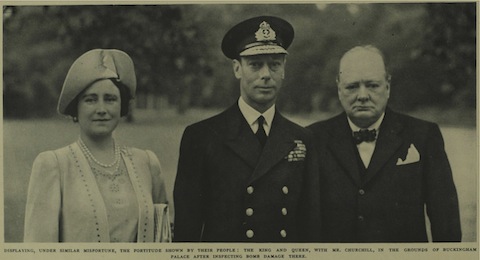
The emphasis is much more on the ‘Illustrated’ and less on the ‘News’. There are a total of three pages of commentary on the war, and even those are punctuated with not-always-relevant images such as the above one of the King, the Queen and their Prime Minister after inspecting bomb damage at Buckingham Palace: ‘DISPLAYING, UNDER SIMILAR MISFORTUNE, THE FORTITUDE SHOWN BY THEIR PEOPLE’. Arthur Bryant’s regular column appears on the same page (358). As you might expect from a popular historian (he’s the biographer of Charles II and Samuel Pepys) his writing is full of allusions to other glorious days when England (not Britain) was threatened by foreign invasion. As he himself says (after pretty much retelling a story which ‘needs no re-telling’, that of Trafalgar):
the threat of invasion brings all the English past to aid the present.
For example, Bryant quotes extensively from Elizabeth’s Tilbury speech, as preparations were made to repel the Spanish Armada:
I know I have the body of a weak and feeble woman, but I have the heart and stomach of a King, and of a King of England too, and think foul scorn that Parma or Spain, or any Prince of Europe, should dare to invade the borders of my realm.
‘Let tyrants fear’, indeed. But other parts of Bryant’s article seem curiously ambiguous, given his right-wing politics and perhaps pro-Nazi views:
In a thousand years there have only been two successful [invasions] — the first when Norman blood and leadership had still to be grafted on to the national stock, and the other in 1688 when nine-tenths of the English people, including Mr. Churchill’s distinguished ancestor, were secret “fifth columnists,” who wished the Protestant invader god speed.
Having said that, Bryant is candid about his previous support for appeasement, while committing himself to the war:
The writer was one of many millions who did not want this war, who wished, like the isolationists in America, to live and let live. The German leaders willed it otherwise and will it so to-day. There is nothing for an Englishman to do now but conquer or die in the last ditch. We have no doubt now but that we shall conquer.
Well, enough of Bryant; let’s see what else ILN has to offer.
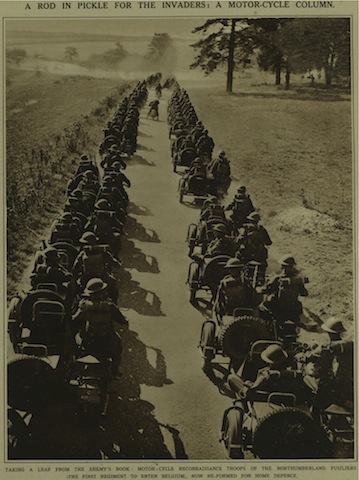
On page 367:
A ROD IN PICKLE FOR THE INVADERS: A MOTORCYCLE COLUMN.
This is ‘TAKING A LEAF FROM THE ENEMY’S BOOK’, a unit of the Northumberland Fusiliers reformed after Dunkirk for motorcycle reconnaissance. Apparently, ‘the side-car is rapidly taking its place [..] as a great asset in mobile warfare’.
On page 368 begins another regular feature of the ILN at this time, an analysis of the war by military historian Cyril Falls. He has this to say on the nightly air-raids on London:
The bombing is, of course, far less accurate than day bombing, and tends to that indiscriminate destruction and slaughter which the whole world anticipated with so much horror at the outbreak of this war. Nothing more ghastly can be imagined than a long-drawn-out campaign consisting almost entirely of night-bombing attacks on great cities. It might go far towards disrupting civilisation itself, and indeed, even if civilisation survives this war without suffering irreparable damage, it will be doomed sooner or later to extinction unless it can succeed in mastering and controlling the dreadful, semi-blind monster of destruction to which it has given birth.
Frankenstein’s monster lives again.

As to an invasion, Falls hopes it will come, because he believes it will be ‘heavily defeated’, destroying ‘Vast numbers of troops’ and perhaps ‘the remainder of the German Navy’ (369). A failed invasion might ‘decide the fate of the war’. But he thinks it won’t come, because the Germans just aren’t ready. Take, for example, the invasion barges, taken from German rivers and canals and shown above.
People breathe the word “barges” as though it comprised some magic. In fact, barges are of small use by themselves, formidable as they may be if used in conjunction with larger craft and operated from suitable ports. Barges, self-propelled or not, are essentially short-range and (from the point of view of landing troops, not from that of seaworthiness) fair-weather craft.
He says that the ports at which the German invaders would have to embark onto these barges were ‘demolished once in the Continental campaign and subjected to tremendous bombing since’, and ‘Imagine the difficulties of loading them without port facilities’. The Germans would need to use larger passenger steamers, perhaps operating from Norwegian ports, harder for the RAF to get to. But ‘the Navy, our bombers, and our excellent coast defences’ along with the Army ‘surely’ can be relied upon to handle whatever the Germans do try.
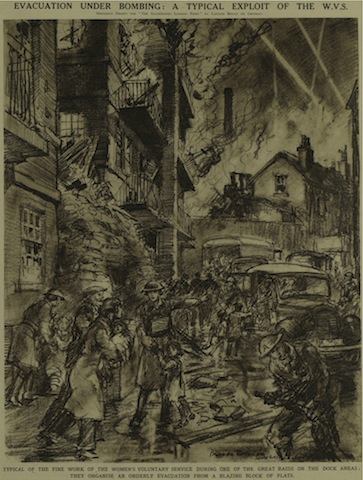
On page 371, an illustration specially drawn for the ILN by Captain Bryan de Grineau, celebrating the ARP work of the Women’s Voluntary Service:
EVACUATION UNDER BOMBING: A TYPICAL EXPLOIT OF THE W.V.S.
The incident shown took place in Rotherhithe, where a block of ‘modern “model” flats was bombed and set on fire’:
The Borough of Bermondsey W.V.S. proceeded to the scene with a fleet of motor vehicles while the attack continued, and evacuated the hundreds of inhabitants from their shelters under the burning building. The whole operation was performed in most orderly and praiseworthy fashion — car after car and lorry after lorry being filled and driven off with its allotted load, the coolness of the W.V.S. averting panic among the rescued as they shepherded them into the vehicles and drove them to accommodation arranged for them in a less dangerous area.
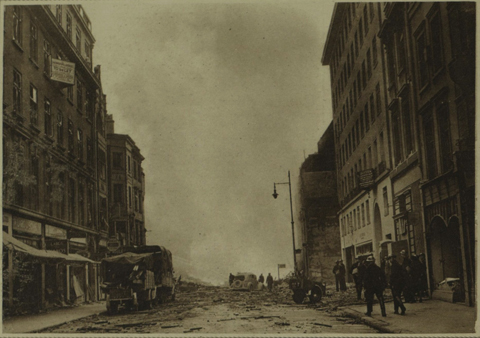
Of course, there are plenty of photographs of bombed-out houses and rescue workers with brick-dust on their clothes. This and the following are from page 378:
CLEAR EVIDENCE THAT SHOPS AND CIVILIAN PROPERTY FORMED THE MAIN OBJECTIVES OF NAZI NIGHT BOMBS: DAMAGE IN A LONDON STREET, WHERE FIRES WERE STARTED AND BUILDINGS DEMOLISHED.
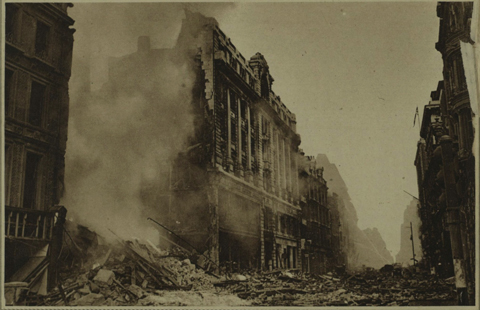
THE PRESS PHOTOGRAPHER IN THE POST OF DANGER — A PICTURE TAKEN IN A LONDON STREET IMMEDIATELY AFTER THE EXPLOSION FOLLOWING THE BURSTING OF A BOMB.

And there are the advertisements, which tell you a lot about the readership (greatcoats for officers being a popular item, for example). This one is from Harrods: ‘Shelter Sense — Ideas for your Comfort’. For example there is the ‘men’s shelter suit’ which ‘zips on in a second over your pyjamas’ (45/-); the camp mattress, ‘comfortable as can be’, and as it rolls up would be ‘suitable for A.R.P. or military purposes’ (29/6 in green rot-proof); and the large woollen ‘warm rugs’, ‘essential in your shelter’ (35/6). The implausibly cheerful couple on the left are both carrying their gas-mask cases, but after changing into his dressing gown he has lost his. He has a pipe, though, so I suppose he’ll be alright.
 This work is licensed under a Creative Commons Attribution-NonCommercial-NoDerivatives 4.0 International License.
Permissions beyond the scope of this license may be available at http://airminded.org/copyright/.
This work is licensed under a Creative Commons Attribution-NonCommercial-NoDerivatives 4.0 International License.
Permissions beyond the scope of this license may be available at http://airminded.org/copyright/.

Tobacco smoke – long proved as an antidote to all poison gases.
You won’t be surprised to learn that I’m pleased you’ve turned up somebody, ie Cyril Falls, writing calm common sense about the invasion threat.
Looking at the colours the women’s suit comes in is a reminder that the Battle of Britain wasn’t quite a clear cut struggle between good and evil.
Gavin: At first I assumed this was an ironic comment about the hideousness of some 1940 fashions; looking more closely at the ad was a bit of a shock. Which it shouldn’t be, really, given that we’ve all seen The Dambusters – just a salutary reminder that the myth of the Finest Hour effaces some uncomfortable truths.
Not, as I understand it, an uncommon use of the word in the 1940s, at least in Britain. The “n*****-brown coat” was a standard item in the high street.
So is the story about Guy Gibson’s dog being derived from the Spanish (rather than the American usage) plausible?
Neil was certainly paying close attention!
The Wiki page on the word has a sub set of the British English use, which answers Errol’s question (no – it’s just contemporary English) and there’s a ref to the cloth colour term use from China, recently.
It was just another one of those acceptable words in the 1940s that aren’t acceptable now.
Not acceptable now, certainly, but I wonder if in this case, it might have diverged so far from any racial connotation as to be merely a synomyn for ‘black’. NB – do not mistake this remark for any attempt to deny that in 1940 casual racism was widespread at all levels of British society.
I was dissapointed by a note in the foreword to a recently-published collection of a New Zealander’s letters home from the Boer War. It apologised for the use of the word in question, but made no mention of the casual racism by the soldier (his attitude changed over time, BTW). I found the focus on a single word, rather than the attitude and actions displayed, odd.
Chris, it was originally a term for the colour, as the Wiki page covers, quite well I think.
Errol, from my experience, a focus on terminology rather than action and attitude is typical of today’s infamous PC brigade. I encountered this working in local UK County governance, where great care was taken to use the acceptable euphemism, while ignoring or stripping people of their actual humanity.
I saw this picture of what I now learned to be 3 year old Eileen Dunne in 1940. The picture was taken by (appearently) popular celebrity photographer Cecil Beaton. The Picture evoked such emotions in me, having 2 small girls of my own who are 3 and 5. Though I know that If little Eileen Dunne is alive today then she is 74 years old. What i would like to find out, is just THAT. And ifher family survived the German Blitz of London. How is it possible to find out this information?
That’s a good question, Eric, and unfortunately I don’t know the answer. I’ve had a look in various online newspaper archives but can’t find any reference to her after 1940; her name is mentioned in a number of books but only as the subject of Beaton’s photograph, not as a person in her own right. Maybe someone will come along with the answer…
Hello guys,
I need your help PLEASE. I care for an 88 year old gentleman (ex R.A.F) and he is very frail, with 10 & 5 % eye sight/vision. I would like to get a copy of a speech his dad made after WW2 to King George, on behalf of the Bermondsey Civil Defence. His father, the very late Mr Harold Travers (M.B.E) was chosen to give a Salute to King George after WW2, which he did at the BBC. I also hav ethe ORIGINAL typed speech that Mr HArold Travers typed himself. Harold Travers was photographed with Queen Elizabeth ( later Queen Mum), doing an inspection of the Bermondsey C.D, I think the then Mayor of the district was with them. HArold Travers received an M.B.E – due to his involvement with the Civil Defence. Now Harold’s son, Jack Travers, is ailing and his life has been very dull and boring due to his lack of eyesight. I framed his dad’s M.B.E, the photo of Harold and the Queen (& others) as well as the speech Harold made. (It was a salute to the King) on behalf of the Bermondsey Civil Defence, which I gather, he was instrumental in starting up(?). Just to be lead in the right direction would be a great help. Mr JAck Travers lives in South Africa so it is very hard for me to get hold of the archives, or even where to start looking. i have contacted the BBC, but they cant answer everyone. There that is my plight, I so want to let him hear his father give the salute, he was so proud of his dad. Can anyone help.
Kind regards,
Martine Dann
South Africa
What a lovely idea! I wish you the best of luck in finding the recording (though I worry that it may not have survived the years). However, I can’t help very much as I’m even further away from the BBC Archives than you are (Australia). I do however follow their Twitter account @ArchiveAtBBC and would be happy to bring your request to their attention. But could you provide a date for the broadcast, even a year at least? That would narrow down the search tremendously and make it much easier for someone to help you.
Hello Brett,
Thank you for that Twitter account, (I have not really Twittered much, possible once & I think it went AWOL!!) anyhow I will persevere and hopefully I can get something from the BBC, I really am counting on this, my Mr Travers is staring to feel very weary of late, as his beloved doggie. Oh I so wish I could get a date, Jack Travers just cant seem to give me a date, he has Alzheimer’s/Dementia setting in, so his memory is not good and it comes in fits & starts. I try every now and then to jog him memory, some days are diamonds, some days are humble and real. So please put a prayer on a wing for me, that I might get a copy frm someone, somewhere, somehow! mmm.. time for coffee!
see ya
Ps whereabouts in Australia are you? It is so sad to see those fires raging, my heart goes out to all the people and animals, such a tragedy! The wonderful work the firefighters do, they deserve medals, all of them!
Aah silly me, I have only now read the very bottom of the page, sorry Dr Holman I see you are from Melbourne!
Thank you for a very interesting site, it is bookmarked!
Thanks — yes, I’m in Melbourne so I’m safe though my mother and brother were not far at all from one of the bushfires earlier this week.
Shame that you can’t get the date from him, but he might not remember it too well anyway. I was hoping it might be on the typescript of the speech or somewhere. I would guess it was in 1945 or 1946, or maybe 1947 anyway. I’ll send a tweet to @ArchiveAtBBC and see if they can help.
@ArchiveAtBBC did get back to me, but weren’t able to help directly. They suggested trying some of the contacts listed here. Probably the most relevant is the National Sound Archive at the British Library. I suspect you would have to be in London to actually listen to anything, but they may be able to help you determine if a recording still exists, which would be a start — maybe try contacting the Humanities Reference Service and Sound & Vision Reference Service here. Good luck!