


I recently read Sonya O. Rose’s Which People’s War? National Identity and Citizenship in Wartime Britain, 1939-1945 (Oxford: Oxford University Press, 2003), which is interesting on such subjects as anti-Semitism during the Blitz. But I kept being drawn back to the front cover, for a completely trivial reason. The illustration is from a 1941 poster designed by Philip Zec (the Daily Mirror‘s political cartoonist), ‘Women of Britain, come into the factories’. The bombers in flying in the stream over the woman’s head are clearly highly stylised, and nearly all identical. But one of them is different, the one above her right arm. In the following close-up, it’s the one on the far left:
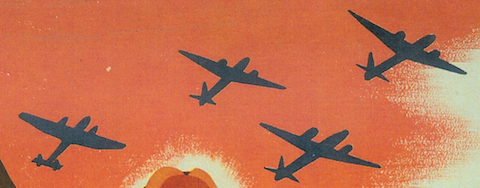
Note the twin tail and the shape of the wings, distinct from all the other bombers. Maybe it’s meant to be a Whitley, though there’s not much point in trying to nail it down. Why did Zec single this one out? I’m sure I’ll never know, and I’m even more sure that it’s not important. It’s just another historical curiosity.
 This work is licensed under a Creative Commons Attribution-NonCommercial-NoDerivatives 4.0 International License.
Permissions beyond the scope of this license may be available at http://airminded.org/copyright/.
This work is licensed under a Creative Commons Attribution-NonCommercial-NoDerivatives 4.0 International License.
Permissions beyond the scope of this license may be available at http://airminded.org/copyright/.
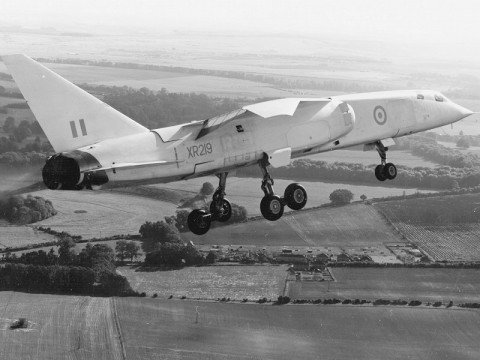

It is very clearly a nicely done Whitley, and one explanation which makes senee to me is that it was the first one he did.
It would make sense if the sequence of the artwork was female figure first, then Zec decided he needed to fit a bomber into that space between her arm and head, as the most difficult spot to fit one in, and planned to scale the others based on that one. After doing that one, he may well have decided it was too much work, and did more stylised planes for the rest.
Of course, forensic graphic art is not my field, so this may be total horseradish – but I do have a Phd so it is plausible total horseradish!
The simplest answers are often the best!
The other aircraft has the vague outline of a Wellington. Not accurate but even the Whitley is stylised. Would fit the time frame of the poster as these were both 2 of Bomber Commands key bombers during 1941 before the heavies came online in 1942.
But hold on!
Surely the lower right of the leading four planes has a different profile to the others . . . possibly a jet with a radome nose?
Prescient? Or sinister? Or prescient and sinister?
I’m going for option (d): other :)
Neat one.
It’s building castles on sand to try and offer certainties on generalised designs in art, but I think Mike’s scenario is perfectly credible. I ran it past Mrs JDK, the art historian, and she thought it interesting and that Mike’s suggestion was good. She also added that the artist may have chosen a design to relate to the woman’s arms or position, and then done simpler aircraft as it wasn’t that strong a part of the composition.
She also says it could be there was a screw-up on the plate and a modified bomber was sketched in to cover it. (She says that’s very unlikely, but we all know these things do happen!)
The aircraft formation echoes the similar layout of the ’28 new Empire flying boats’ poster with more representational Shorts C Class: http://collections.nasm.si.edu/media/full/A19900983000cp02.jpg
In that the tanks just visible seem to be genericised cruiser types, owing something to the Valentine tank, it’s not any ‘real’ tank and not even very like any. Likewise, the rough shape of the majority types echoes the pointed wings and layout of the VA Wellington, but isn’t, there’s more that’s different to the Whitley as there is alike, I’d say.
Also anyone who saw any Whitleys fly, or action photos, would be aware of the very nose down stance of the type, due to the wing having a bizarre angle of attack. Incorporate that in a poster? Probably not, but it’s another facet of the real thing not illustrated.
Following Ross’ comment, we can observe that pre-war most ‘heavy’ bombers recognisable to the British artists were twin engine types (the third Briton being the Handley Page Hampden). In fact the wings of the ‘other’ bombers are more like the Hampden’s than the Wellington’s, with the straight across leading edge.
Then we’ve noted that the tail of the solo bomber is ‘Hampden like’.
In some ’30s stamp design, generic rather than specific was critical, so an artist would incorporate aspects of different aircraft to ensure the aeroplane depicted was credible, but not a real one. We may have something like that going on here. After all, Factory owner A would’ve cut up rough if the aircraft in the recruitment poster featured aircraft from factory B.
I think my castle is suffering from sand erosion…
Still, it’s an impressive castle. I doubt we’re going to get much closer to the real reason why, unless Zec left some other evidence behind. I guess my only problem with the ‘mistake’ theory is that presumably he would have made one or two test sketches first?
If I understand Mrs JDK’s comment correctly, the ‘mistake’ wouldn’t so much be Zec’s, as a fault or problem with the printing plate/s after the design was completed which was covered by ‘modifying’ the bomber to cover, say, a scratch.
Very unlikely, but these things do (did) happen! Certainly some of my printing errors remain as inexplicable to later viewers – I hope…
Apologies. I’ve turned up very late to this party and so probably having missed the best bits. And what’s more I’ve brought a bottle of wine bought at a garage forecourt in the form of a particularly weird idea.
Could the aircraft be a nod to the Soviet Petlyakov Pe-2 bomber with the twin tail and very long pointed engine nacelles?
The style of the poster says ‘heroic Soviet’ (to me), the date of product – according to IWM’s Collections on line website – 1941 and Zec worked for the Daily Mirror which has traditionally been to the left of centre in British politics.
Just a muddled thought…
Hi Richard,
Neat thought, but given the other aircraft are definitely not representing any particular type, it’s less likely that one is. Agreed about the left leaning, but I can’t see anyone going for a Soviet type being produced in British factories – except, perhaps as an ‘in joke’. As always the simple explanation, that it’s a generic type, is almost certain to be correct – but it’s been fun to speculate!
Hi in turn JDK.
I think you have missed my point. Subtley is the key here.
I suggested (and still do) that the aircraft was a ‘nod’ to the Soviet design – not an actual depiction of an actual aircraft, or indeed an actual factory or women for that matter.
As a former graphic designer and illustrator I had a file of reference material either physical or in my head covering styles, machines and similar.
These were (like photographs) used to jump-start the creative proess. Indeed I was taught to use these materials to produce an image and then use that image as reference to produce a more refined one, one that had the main characteristics but not the ‘clutter’ of the original.
As for an ‘in joke’, this again is not my point.
Given that the British Ministry of Information could at times be very conservative in its tastes it might not take kindly to overt support for an ally that was until recently an enemy – an ally that it could be argued was only an ally because of the ‘my enemy’s enemy is my friend’ sentiment.
So why not sneak in a particular ‘homage’ to the Soviets, people Zec admired by a suggestion – nothing more – of a Soviet aircraft?
As for speculation yes that IS the point.
Brett noticed something that many others – including myself have missed – the fact that all the other aircraft were of a similar design. As you know he wrote…
‘… there’s not much point in trying to nail it down. Why did Zec single this one out? I’m sure I’ll never know, and I’m even more sure that it’s not important. It’s just another historical curiosity’.
And yet I am sure many people have read the post and wondered. Some of us have felt the urge to post our comments – you have three in this string alone – in an effort to find an answer to something that has no definite answer.
A solution will evade us until some documentary evidence is published – Zec’s diary, an exchange of letters with the Ministry of Information or similar – but until then I suspect the game will continue.
And Whitley’s and Wellington’s amd mpre will have their supporters and detractors.
Thanks, Richard and JDK. I think whether it’s an in-joke or a subtle nod is much of a muchness — the main point is the suggestion that it’s a reference to a Soviet type. I agree the poster is Soviet heroic in style, as does (more persuasively!) the V&A. There’s another issue though, which is would Zec have known about the Pe-2? According to that V&A link the poster was part of a December 1941 campaign to get more women into factory work. The earliest reference I can find to the Pe-2 in a quick check of the papers is from 29 January 1942, when it is described as ‘Russia’s latest bomber’, the details of which are ‘still closely guarded secrets’. There’s a photo, though it doesn’t show the tail. The dates don’t quite fit but that’s not conclusive — if there was a slightly earlier photo, or Zec’s contribution was slightly later, then he might have known about it (and it would certainly have been topical). So, could be!
Pingback: ‘Women of Britain – Come into the Factories’, a Soviet-style image urging women to work in wartime factories – volunteer london blog