
October 2009

You are currently browsing the monthly archive for October 2009.

Shirley Jacobs writes to inform me that the W E Johns Appreciation Society now has a website. It's clearly quite an active group -- there's a magazine, Biggles Flies Again, published twice a year, and regular meetings with the next in Derby on 24 October. Via the site, one can keep up with W. E. Johns, Biggles, Worrals et al in the press, or explore the wider world of Bigglesiana on the web. (Which introduced me to a site devoted to Popular Flying, a magazine edited by Johns which featured articles by a number of airpower writers familar to me, such as J. M. Spaight, E. Colston Shepherd, Arch Whitehouse and Nigel Tangye.)

At one point I had managed to work in a brief reference to Biggles in my thesis, but sadly had to cut it for reasons of space. So here's what I was going to say!

And even Biggles, the flying adventurer whose popularity with boys dates from this period, got into the act [of popularising the knock-out blow theory] in Biggles and the Black Peril (published 1935), foiling German plans to set up navigational beacons on the English coast in preparation for a sudden and massive air attack.

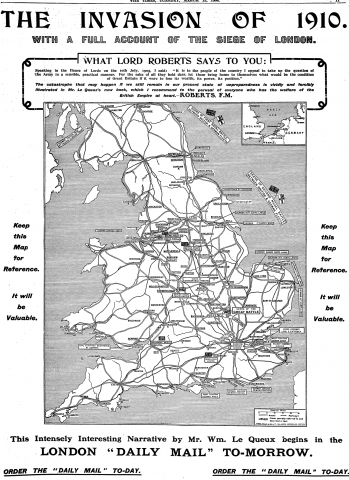
The Invasion of 1910

William le Queux's The Invasion of 1910 is today one of the best-remembered of the Edwardian invasion novels (at least to anyone interested in the topic). Not because of any literary value -- very few people read it today, and I can't blame them -- but because of its contemporary success. It was commissioned by the press magnate Lord Northcliffe and serialised in his Daily Mail in 1906. And heavily promoted in all his papers, as we can see here -- this is a full page ad from The Times (13 March 1906, 11). The Invasion of 1910 was a huge hit, selling many newspapers and over a million books in a couple of dozen languages, making it the most successful future war story since The Battle of Dorking back in 1871. Northcliffe being Northcliffe, there was also a political objective: the scuppering of the government's proposed Territorial Force, which was widely derided by Conservatives as an ineffective substitute for conscription (sorry, 'national service'). The ad and the book both feature a personal recommendation by Field Marshal Lord Roberts, president of the National Service League.
Read the rest of this entry »

I bought these the other day, about 17000 km away -- except for one which was a gift.

The Battle of Britain: An Air Ministry Account of the Great Days from 8th August -- 31st October 1940. London: His Majesty's Stationery Office, 1941. Thanks, Simon!

Angus Calder. The People's War: Britain 1939-1945. London: Pimlico, 1992 [1969]. A classic which I've not yet read.

Richard Overy. The Air War 1939-1945. Washington, DC: Potomac Books, 2005 [1980]. Likewise, I'm afraid to say! This edition has an essay on the most important updates to the literature since 1980.

Martin Pugh. We Danced All Night: A Social History of Britain Between the Wars. London: Vintage Books, 2009. What you'd expect from the title, but also has a whole chapter on 'the romance and the menace of aviation'.

Sonya O. Rose. Which People's War? National Identity and Citizenship in Wartime Britain, 1939-1945. Oxford: Oxford University Press, 2003. One way to tell when a book has become a classic is when other books start alluding to it in their own titles ...

Newer entries »