

January 2008

You are currently browsing the monthly archive for January 2008.

Lord Trenchard's Choice

I’ve recently come across what appears to be a new biography of Marshal of the Royal Air Force Hugh Montague Trenchard, 1st Viscount Trenchard, 1st and 3rd Chief of the Air Staff, etc: Sylvia Andrew, Lord Trenchard’s Choice (Richmond: Mills and Boon, 2002). I say ‘appears to be’ because there are serious discrepancies with the received historical account of his life, which must call into question the accuracy of the author’s research.

Here’s an extract from the book, followed by a blurb (both from here, though I’ve nabbed the cover from here):

“You leave him alone, do you hear?” The voice rang out, high and clear. Ivo winced as the sound sent his head throbbing again, and slowly turned. The next moment headache, heartache, everything was forgotten as he stared into the muzzle of a pistol, which was pointing directly at his head, not ten paces away. It was in the hands of a boy that couldn’t be more than eleven or twelve. Ivo shivered as a chill ran down his spine. Guns in the hands of children could be fatal, and this boy looked angry enough to shoot him.

“You scum!” the boy went on without moving. “I suppose you mean to sell Star at Taunton, along with the others you have stolen.”

If it didn’t rile the mind of Ivo Trenchard, of the 7th Hussars and the most polished man in Europe, to be mistaken for a simple horse thief, finding that the urchin pulling a gun on him was a teenage girl certainly did! Joscelin Morley both dressed and lived her life as a boy in a futile attempt to please her father. Her future was clear: Marriage to her neighbor Peter was to join the two estates and they would settled down to care for the land they both loved. So where did the worldly Ivo, her godmother’s nephew and a terrible flirt, fit into the equation?

I admit that I’m assuming that ‘Lord Trenchard’ here refers to the 1st Viscount Trenchard (the title was created for him), and not to either his son or grandson — though they’ve both had worthy careers in their own right, and meaning no disrespect to them, neither seems to merit a biography. The 1st Viscount has already had one written about him (I’m reading it at the moment, as it happens) and is probably overdue for another interpretation. But I don’t think Lord Trenchard’s Choice can be it. I mean, he wasn’t called Ivo (unless that’s a nickname); he was in the Royal Scots Fusiliers, not the 7th Hussars; and as for ‘the most polished man in Europe’ and ‘a terrible flirt’ — well, that’s not any Boom Trenchard I’ve ever read about. That cover art is terrible, it looks nothing like him (and what’s with the Jane Austen getup?)

Still, don’t judge a book by its cover and all that — I should at least flip through its bibliography and endnotes first. (And Trenchard was in fact born in Taunton, so that reference looks right.) So who knows, perhaps there’s room for a feisty cross-dressing pistol-wielding Somerset lass in the Father of the RAF’s life.

Things

For the last couple of weeks I’ve been using the free preview of Things, a task management application for OS X. I’ve just entered the final year of my PhD — or rather the final year of my PhD scholarship, which may not be the same thing — and so keeping track of everything I need to do is going to be critical. I’ve been looking for something like Things for ages, actually. Nearly all of this type of software seem to be based on Getting Things Done (GTD), a system for task management which is hugely popular, at least among techie types. But I’ve never been able to wrap my head around it, it seems too strict and hierarchical. The applications designed to help you follow it seem just as bad — you’re forced to fill in a bunch of text boxes or select from drop menus or whatever, and it’s all just too annoying for me.

That’s why I like Things, so far — you can fill out as little or as much info as you want for each task. The organisation of tasks is logical (at least to me), the interface is polished but unobtrusive and the program lightweight. It just gets out of the way and lets you get on with things. Apparently it does actually conform to GTD principles, but doesn’t force you to follow it if you don’t want to. The data is stored in an XML file so you can retrieve it if something happens. Tags are used throughout, which is a nice touch. Tasks can be organised by time priority (eg ‘Today’, ‘Next’) or as part of a larger project. When you’ve completed a task, you tick a box on its pane and it will eventually vanish out of sight into a log of completed tasks. It’s probably not the place for detailed notes (I use VoodooPad for that) but works well for jotting down things you need to do, when you think of them.

Things is only a time-crippled beta at the moment, but I’ve found it to be completely stable (there are features which aren’t implemented yet, however, such as collaboration with other Things users). I’ll almost certainly be buying the full version when it’s released; but I have to say the price seems a little steep at US$49 for what, after all, is not a huge program. Being able to get things done is probably worth that; but I’d rather pay US$39, which is the price you can get it for if you sign up to their newsletter before 31 January (which I did a while back and haven’t received a single email yet). Hopefully this doesn’t sound like an ad (NB: I am not connected with Cultured Code in any way), but perhaps there are some Mac users out there who need task management as much as I do right now — if so, Things is worth looking at.

A few days after Xmas, I felt like I should be getting back into reading something thesis-related, but at the same time I still felt like I was still in holiday mode. So I compromised and read something on topic, but a bit lighter than my usual academic fare, namely Waiting for Hitler: Voices from Britain on the Brink of Invasion by Midge Gillies (London: Hodder & Stoughton, 2007). The name suggests that it’s along the lines of the ‘forgotten voices’ type of book that seem to be everywhere lately, but I couldn’t say because I haven’t actually read any of them. While it’s certainly heavy on quoting ‘ordinary’ people (Mass-Observation diarists, Dunkirk veterans, internees) and, I’m sure, doesn’t break any new historiographical ground, it’s based on a lot of research, is well-written, and easily moves between the big picture and the small one. I learned a lot about a topic I don’t know much about, namely the British home front from the start of the Norwegian campaign in April 1940, to the start of the Blitz in September. It’s easy for me to focus too much on the Battle of Britain and the Blitz, but in some ways the period leading up to them is more interesting, because people didn’t know what was going to happen next and that’s often when fears come out to play.

One of the aspects of Waiting for Hitler I appreciated was Gillies’ attention to rumours and panics as an index of the insecurity of the British people as they prepared for a possible German invasion. These are fascinating. For example, the slit trenches being dug in Hyde Park were said to be for mass burials in the aftermath of air raids, not protection from bombs. Troops practicing machine-gunning a buoy in a Cornish harbour turned into the accidental death of a boy by machine-gun fire the next day, and then the massacre of dozens of children on the beach the next, strafed by German aeroplanes. Rumours turned the deputy Labour leader Arthur Greenwood into a traitor locked in the Tower, and pencils and chocolates into the poisoned weapons of fifth columnists. In Southampton, the smell from a pickling plant was responsible for a minor panic, when somebody thought it might be poison gas:

ARP wardens paraded in gas masks, while hairdressers slammed their windows and told customers to keep their heads in washbasins.1

It may sound silly, but it wasn’t really, because the government’s ARP literature warned people to be wary of strange smells as possible evidence of a gas attack.

Stories abounded of new German weapons. For example:

there were tales of German experiments with a cobweb-like material that they had tested over France in 1939. The substance, which they released in large white balloon-like capsules, had covered several square kilometres and clung to people’s hands and faces. In another version it was reported that the substance had appeared over Britain, but it turned out that this was gossamer produced by spiders mating in mid-air.2

Most of these weapons didn’t exist, but the rumours helped explain to those who passed them on why so many armies were crumbling so quickly before the German onslaught. One of the weapons was quite real, however: the paratrooper.
Read the rest of this entry »

  1. Gillies, Waiting for Hitler, 159.
  2. Ibid., 160.

This post relates to my trip to Europe in July-September 2007.

Housesteads

Day two on the Roman frontier. This took some careful poring over the tourist bus timetable (route AD122, of course) to try and maximise the number of sites I visited while spending enough time at each one. This turned out to be be a non-trivial problem — the gap between buses varied considerably, and sometimes the buses stopped in Haltwhistle instead of going beyond, so I was having to make calculations like, ‘well, I can go to A in the morning and be there at opening time, but then the bus to B is either 45 minutes later or 3 hours 45 minutes later, which is either too short or possibly too long, but if I want to take in C as well I really need to take the earlier bus because there’s no other way to get there. Or I can go to C first, then come back to B but I’d only have an hour there …’ And so on: it did my head in! It turned out that there was really no sensible way to do more than 2 places, so I crossed the Roman Army Museum off my list and settled on Vindolanda and Housesteads. I didn’t have cause to regret this, as they were both even more absorbing than Chesters had been.

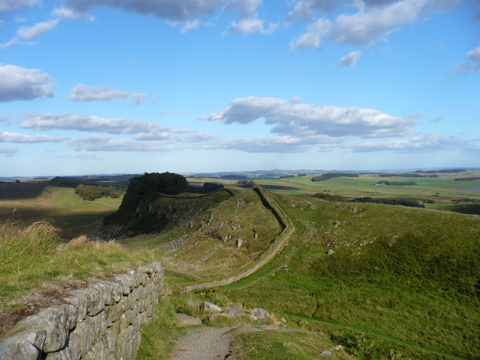
The above photo, incidentally shows Hadrian’s Wall itself, looking back towards Housesteads from the west (it’s past the big clump of trees on top of the cliffs).
Read the rest of this entry »

While missing out on a Clio may have been entirely predictable, having a post included in On Line Opinion/Club Troppo’s exhibition of the best Australian blog posts of 2007 was completely unforeseen! It’s a very pleasant surprise, and the exposure is nice too (On Line Opinion has something like 145,000 readers a week, according to Wikipedia). My post is here; all of the best posts are listed here.

I have to say, though, the post in question is not something I would have picked for my best of 2007: I don’t think it’s particularly well-written or insightful. Commenter Pericles would seem to agree: ‘What a strange piece. I had thought that the practice of delving into the past and finding odd observations about “overseas” had long passed its use-by date’. Arrrgh — and here was me thinking that anything that the proper study of history was anything and everything that had happened in the past for which records still exist. Why do I never seem to get these memos? Is there some mailing list I should be on? It’s especially bad news for historians of Tocqueville and the like. And somebody should tell George Simmers that his examination of D. H. Lawrence’s opinions of Australians ‘is an entirely pointless exercise, and a stunning waste of your time and mine’, since Pericles uses that very example for our instruction. Anyway, thanks, Pericles, for letting me know — won’t happen again.

A recent post on the new science fiction blog io9 (which I’m enjoying, but is it really so hard to put in spoiler warnings?) claimed that the Vickers Velos was the ‘ugliest and most worthless plane in the world’. Sure, it’s not pretty, but I’ve seen plenty that were uglier — fuglier, even. But there were a couple of links to lists of other ugly aircraft, which are always fun to browse. The first one had some bizarre nominations (the Dragon Rapide should never be on such a list) but I thought I’d found what may be the single ugliest aeroplane ever made, the three-engine variant of the Farman Jabiru airliner (it’s French, naturellement). I was going to write this post about it. But then I clicked through to the second list.

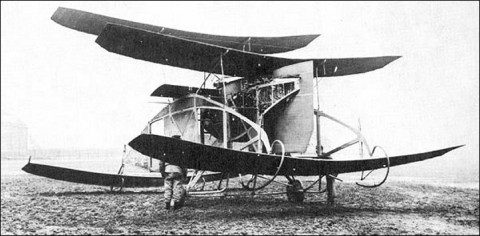
That is where I first saw the Vedo Villi.

I can’t take my eyes off it. I honestly can’t decide whether it’s ugly or beautiful. But it is somehow deeply, fundamentally, disturbingly, horrifyingly wrong. It is eldritch. It’s like something H. P. Lovecraft might have dreamed up, if he’d been an aircraft designer and wanted just the thing for the airminded cultist to nip down from Arkham Aerodrome to the nightmare corpse-city of R’lyeh for the weekend.

There is a photo of the Villi below. Read on — if you dare.
Read the rest of this entry »

Long-time reader, second-time commenter Ian Evans was in the Royal Observer Corps in York at the end of the 1950s. Here he describes how the ROC, in addition to retaining something like its planespotting functions during the Second World War, took on the job of measuring the Third:

When I joined the ROC (1958) it was still pretty much an RAF auxiliary, officers with handlebar moustaches and all. We spotted, reported and plotted aircraft in a very similar manner to our WW2 predecessors, though things had been simplified and speeded up, with special procedures for fast low flying aircraft (Rats). The nuclear reporting role was just being introduced, the observer posts were given “bunkers”, a small underground room with bunks and stores, airlock and reinforced tunnel to the surface, a nuclear burst recorder (a souped-up pinhole camera), a pressure recorder to measure the blast strength, a Geiger counter to measure the fallout, and individual dosimeters (we were rather cynical about these).

The operating theory was that there would be sufficient political warning for the observers to man their posts, they would wait for the noise to stop, surface, extract the recording paper from their recorders, read off the bearing and altitude of the burst and the peak overpressure. This would then be phoned in to Group HQ where we would plot the (hopefully several) bearings, and get the position of the detonation. Then, using the reported overpressures, plus sets of tables and nomograms we woud evaluate the bomb power and report back to…..anyone still alive. After that the posts would report radiation levels at regular intervals until…

Which is quite a terrifying job description (luckily they didn’t have to do risk assessments in those days!)

But, of course, there was plenty of terror to go around. Long-time reader and commenter CK pointed out a 1982 BBC documentary called “Nuclear War: A Guide to Armageddon” (written and produced by Mick Jackson, director of Threads) about the effects of a nuclear war and how civilians should prepare for it.


Read the rest of this entry »

Chesters

This post relates to my trip to Europe in July-September 2007.

Chesters

Leaving York, I took the train north to Newcastle, where I took another train heading west to Hexham, a small town in Northumberland. As nice as Hexham was, I’m sorry to say that I wasn’t there during business hours and so didn’t see much of it. Which is a shame, because there’s a fine 12th century abbey and several other medieval buildings there (I did get to see the railway station, of course, apparently one of the oldest in the world). But that was ok, because I was only there to see Hadrian’s Wall, which runs just north of Hexham on its way from coast to coast.

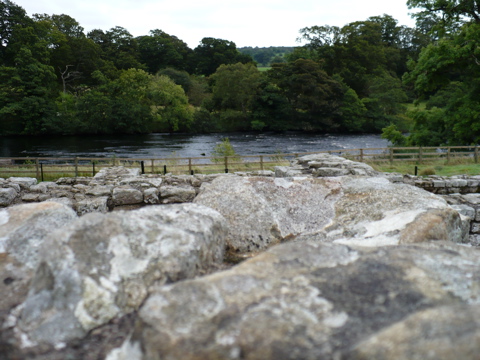
On my first day, I only had time to see one site, so I chose Chesters. Between the 2nd (almost immediately after the Wall was built, in fact) and late 4th centuries it was a Roman cavalry fortress called Cilurnum, sited where the Wall crossed the North Tyne.
Read the rest of this entry »

Military History Carnival #10 has been posted over at Walking the Berkshires. This month, the post I enjoyed the most was at Boston 1775, about various improvised weapon systems which ragtag insurgents hoped would turn the tide against the overwhelmingly superior forces of a colonial power. Ok, it’s a stretch to call these first submarines ‘improvised weapon systems’, as they were pioneering attempts at an entirely new mode of transportation. (The post is more about other proposed weapons, such as ‘Row-Gallies’. I want to talk about submarines though :) But they were also weapons of desperation, of the weak against the strong. The British didn’t need to invent submarines because they already ruled the waves. Why bother with such frail contraptions, more of a danger to their own crew than anyone else? Submarines have come a long way since then. They are integral parts of big navies, though for very different purposes than the Turtle (platforms for SLBMs, for example). Middle powers such as Australia like to have a few around to lurk about and deter any potential aggressors, and to add some heft to their offensive capabilities. It’s in small, coastal defence navies that submarines retain something like their original purpose, as force equalisers. It’s in the North Korean navy and its like that the true heirs of the Turtle are to be found today.

2007 Clios

The winners of the 2007 Cliopatria Awards have been announced. These are awarded for the best history blogging in the last year. If they’re not already there, I like to add the winning blogs to my sidebar and to my RSS reader, both as a very mediocre reward to the victors, and to diversify my reading. This year, that means adding four blogs: In the Middle (best group blog), Religion in American History (best new blog), Zoom (best series of posts, which have featured here before), and Steamboats are Ruining Everything (best writing). They join Cliopatria (best post, by Timothy Burke) and Civil War Memory (best individual blog), both already there.

I’m very pleased about that last one — even though Airminded was also nominated in that category — because Kevin’s passion for his subject and for his teaching makes Civil War Memory one of my favourite blogs. I’ll also note that this means that military history blogs have won best individual blog two out of three times (Blog Them Out of the Stone Age won the inaugural award). And another military history blog (Civil Warriors) won best group blog last year. The military historioblogosphere continues its irresistable advance!

This post relates to my trip to Europe in July-September 2007.

Black-Out

While in York Castle Museum, I was surprised to come across Black-Out, a ’skilful card game — full of interest’. It’s one of the British war games I mentioned in a previous post. At that time I only had a low-res photo from the BBC website to go on, so I was glad of the chance for a closer look.
Read the rest of this entry »

York 2

This post relates to my trip to Europe in July-September 2007.

Clifford's Tower

My second (and last) day in York. Luckily, since I’d seen the two major attractions (for me) on my first day there, I was free to wander around with only a vague plan in mind. And there was a lot to see. One of the great things about York, I found, was the way in which nearly all periods of history are represented by some substantial survival or site, all within easy walking distance. It’s like a slice through Britain’s/England’s/Northumbria’s etc past. So, to illustrate this, I’ll write this post chronologically by site (rather than chronologically by time of day visted!) With the exception of the above: that’s Clifford’s Tower, which should come in the middle somewhere, but it’s too pretty a picture not to put up front.
Read the rest of this entry »

I’ve just found the solution to a little LaTeX problem that has been bugging me for a while. To format my bibliography, I’m using the jox.bst (i.e. Oxford) style of the jurabib package. For the most part, this does exactly what I need it to do. But there are a few glitches. The most annoying one is when I have a BibTeX entry with a corporate author, for example War Office. Jurabib treats this as a personal name and so when it comes to alphabetically sorting the bibliography entries, it sorts on ‘Office’ and not on ‘War’. This puts ‘War Office’ after ‘Noel Baker’ in the bibliography instead of after ‘Turner’, which is where it should be. (Yes, this is the sort of trivia you have to worry about when writing a thesis!)

Actually, that’s not really the problem, or at least, it’s one that all BibTeX styles share. There’s a standard solution, though: put the author name in braces in the BibTeX entry: {War Office} instead of War Office. This tells BibTeX not to break the author name, to treat it as a single token. And jurabib does generally understand this — but not if you use the jox.bst style! If you try to do this with jox.bst, you get an error like this:

! Argument of \jb@lbibitem has an extra }.
<inserted text>
                \par
l.1461 \bibitem[{{W}r Office}\jbdy {1922}}
                                          %
?
Runaway argument?

While it does eventually compile, it does so by mangling the bibliography, so that’s not very useful. It would seem to be a bug in jurabib, or at least jox.bst — and as of April 2007, jurabib is no longer under development.1 So it’s not going to be fixed. Periodically, I’ve looked for a workaround (as have others), but nothing has worked for me2 — until now.

The answer: enclose the spaces between the words of the corporate name in braces! So, War{ }Office instead of War Office. That’s all there is to it, and it works perfectly. I don’t understand why, but I don’t much care either! My thanks go to Carsten Ziegert who posted this solution on the jurabib list.

  1. Its developer suggests biblatex as an alternative, though it seems that it’s not yet stable. It does look powerful though; and I see that one historian is already using it.
  2. Double quotation marks are also supposed to work, but don’t.

Yesterday (New Year’s Eve), the temperature here in Melbourne reached 41 degrees Celsius (that’s just under 106 Fahrenheit for those of you in the United States and Belize) — the hottest day of 2007, as it happens. The overnight minimum was 30 degrees (86 for those of you etc), which I think is higher than all but a few days I experienced in the northern summer just past. Today is predicted to be another 40 degree day, though at least a weak change is predicted for the afternoon. Even now (a bit after 11am), it’s nudging 38 outside. Inside, my little flat at the top of my building is disgustingly hot and I can’t think, so I’m going into town to work at the State Library instead, which should be nice and cool. (I do have a sadly-neglected desk in the department, in an air-conditioned room, but they’ve changed the building entry codes or something and I don’t think I can get in.)

But what of the future? All else being equal, as global warming begins to take hold, and the average temperature rises, we will see more days like today and yesterday, and hotter days too. So more and more poor postgraduate students like me, who can’t afford to live somewhere cool, will tend to gravitate towards the SLV. Eventually, a point of no return will be reached: so many postgrads will have gathered there that the mass of the combined SLV+postgrads aggregate will be enough to form a black hole. Then, even if they do finish writing their theses, how will their examiners read their theses? If Hawking is right, they’d have to wait until the black hole had evaporated before the outside world could know what they had written, which of course is no use to them anyway.

So, ultimately, as far as the outside world is concerned, the number of new PhDs being produced will drop to zero. This pattern will recur all around the planet. Australia and other hot countries will succumb first. Countries with colder climes will last longer, but they will fall too, eventually. So historical research will one day grind to a halt. This is the tragedy of global warming!

See, told you I can’t think in this heat. I’m off to the library.

Casualties in Britain due to aerial and shore bombardments, 1914-1918 (monthly)

Well, not just corpses …

The data for the above plot are drawn from the War Office, Statistics of the Military Effort of the British Empire During the Great War, 1914-1920 (London: His Majesty’s Stationery Office, 1922), 674-7.1 It shows the total (i.e. civilian and military)2 casualties (i.e. killed and wounded) from all forms of bombardment (i.e. by airship, by aeroplane, and by warship) in Britain for each month of the war.

There are three distinct, colour-coded stories here. The first is that of naval bombardment (blue). I knew of the German navy’s raid on Scarborough, Hartlepool and Whitby in December 1914, but not that there were so many casualties (137 dead, 592 wounded). That one raid caused more casualties than any of the later air raids — more than were caused by air raids in any one calendar month, in fact — and on that basis the post-war Admiralty ought to have been arguing that the battlecruiser will always get through! Of course, it was a highly singular event: no other shore bombardment came anywhere close to doing as much damage. And most places in Britain were not as exposed to attack from the sea as seaside towns in Norfolk.

The second story is that of the airship menace (green). During 1915 and 1916 Zeppelin raiders were fairly successful, often causing about 200 casualties a month — in those months that they did attack. They mostly came during the spring and autumn; I suppose the summer nights were too short and the winter nights too foul. But after 1916, they inflicted much less damage. That’s partly because they came less often, and that’s partly because in the autumn of 1916, seven airships were shot down by British air defences, including that commanded by the legendary Kapitänleutnant Heinrich Mathy. The RNAS and RFC had largely gotten the measure of the Zeppelin raiders by then.

Aeroplane raiders are the final story (red). Though these are largely forgotten today — at least in comparison to the Zeppelins — from the summer of 1917 they caused even more fear than did the Zeppelins, and the graph shows why: they did significantly more damage, and did so over a more sustained period of time. (They kept up the offensive on London over the winter of 1917-8, for example, which the Zeppelins did not.) The two great daylight raids on London on 13 June and 7 July 1917 were particularly shocking. Though the activities of the Gothas and Giants led to the formation of the Royal Air Force and the London Air Defence Area, ultimately the end of major aeroplane raids owed more to the needs of the German army in France than anything else: first the March 1918 offensive, and then the Hundred Days.
Read the rest of this entry »

  1. Which was kindly scanned by Mike Yared of the WWI-L mailing list, and made available online. Be aware, it’s over 80 Mb in size.
  2. Interestingly, Statistics distinguishes between the two categories (with civilians nearly always predominating). I suppose the point of that was that the lives of soldiers and sailors were expected to be at risk in wartime, whereas those of civilians shouldn’t be.