

Is it possible to love a city? Surely. Is it premature to declare such a love after only having lived in that city for only two months? I don’t think so: after all, you can fall in love with a person practically on first sight. Love doesn’t depend upon your knowing its object deeply, only upon thinking that you do. I only experienced one season, summer (I’m sure it’s a lot less hospitable now); I never cooked a meal the entire time I was there (no kitchen, or at least none I ever found); I mostly stuck to the inner bits where public transport mostly works. It was really a working holiday, and different to how most Londoners experience their city. If I had to live there properly, and experienced the worst of London as well as its best, I might well feel more ambivalent. But until such disillusionment sets in, I love London!
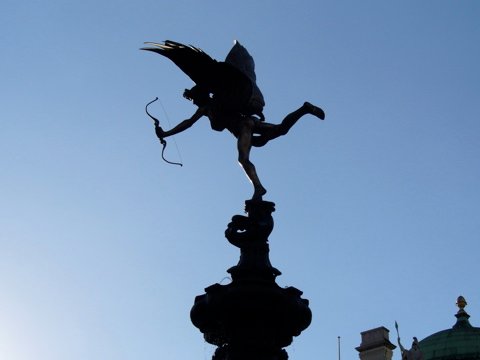
So, to round off more than two dozen posts I’ve written about my time in London, here’s one more, with some photos that didn’t fit in anywhere else. Above is Eros in Piccadilly Circus.
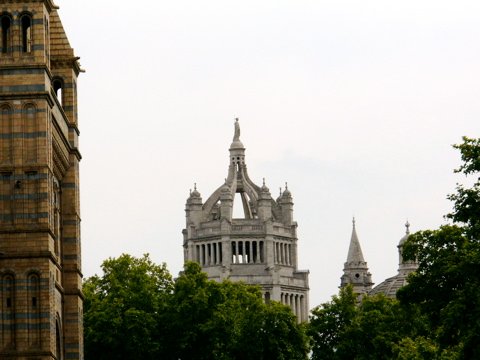
The Victoria and Albert, taken from the grounds of the Natural History Museum. Sadly, I didn’t get a chance to go back and actually go inside.

Waterloo station. A few weeks later I saw The Bourne Ultimatum in York, in which a major set-piece takes place in the station — the first time I’ve had an ‘OMG! I’ve been there!’ moment while watching a movie set in London.

British Library Newspapers, Colindale — where I spent more hours while in London than any other place, with the exception of my room. The area isn’t quite as dodgy as the overturned shopping trolley would suggest … ok, well maybe it is.
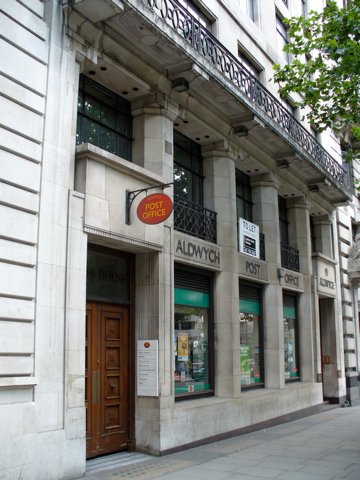
Astor House on Aldwych, across from Australia House. Now it’s a post office. In 1927 it housed the offices of the Air League of the British Empire, during the secretary-generalship of P. R. C. Groves. (Telephone: Chancery 7258.)
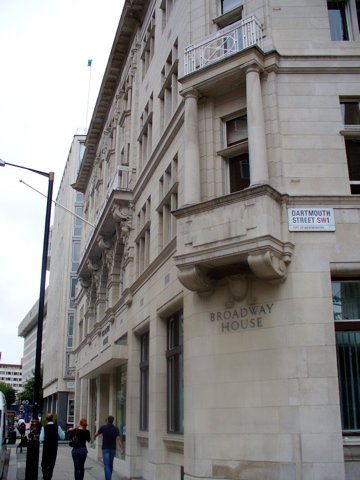
And this is where the Air League (sans British Empire) lives today, on Tothill St in Westminster (across from London Underground HQ) — about midway between Parliament and the Palace. They don’t have the whole building of course, just an office suite in one corner of it.

And this, I think, was where the National League of Airmen had its offices in 1935, on Grosvenor Square (where the US Embassy is) in Mayfair. It’s part of a posh hotel now and they’ve taken the street numbers off, but this was about the right spot.
How many people have ever gone looking for these long-forgotten sites of airmindedness before? Quite possibly none …
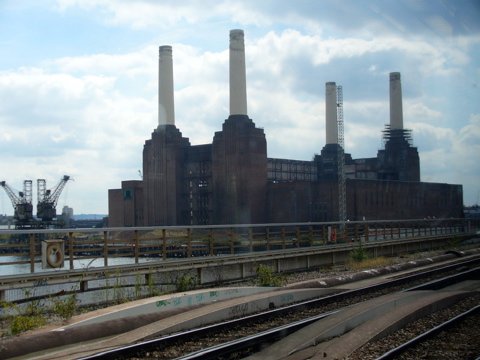
Battersea Power Station, taken out the window of a train, on my way to chez Jakob in Peckham.

The Queen’s Tower at Imperial College, the last remnant of the old Imperial Institute.

All bar the last of the remaining photos were taken on the same day. It was during the Tube strike, I’d spent the day at the Royal Aeronautical Society in Mayfair and had to get to Peckham (again!) for The Dam Busters. Victoria station was not that far away, which worked well for Peckham Rye (not being Underground, the line was still open), and so I walked it. In the course of which I crossed Hyde Park Corner, and in my usual serendipitous way, stumbled on some very cool things I didn’t even know were there. Above is Wellington Arch, a former police station (!) Well, that and a memorial to the Duke of Wellington.

The Royal Artillery Monument. The statues are by Charles Sargeant Jagger, whose soldier figures have a very distinctive style, strong but sombre. I’ve long been fond of his statue Wipers, a casting of which used to stand outside the Museum of Victoria and is now by the Shrine of Remembrance. (The Driver, part of the Royal Artillery Monument, is also there.)
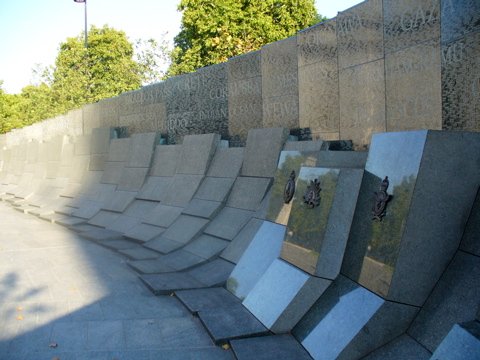
See what I mean about serendipity? The Australian War Memorial, London.
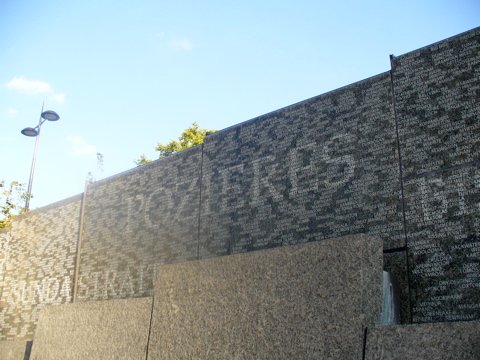
It bears the names of the major battles fought by Australians alongside the British, from Amiens to Ypres. Pozières has been mentioned on this blog several times before.

The battle names are rather artfully composed of smaller names, of Australian towns. I don’t think I’ve ever been to any of the ones in this photo — and I’m sure I’d remember if I’d ever happened across Upper Dingo!
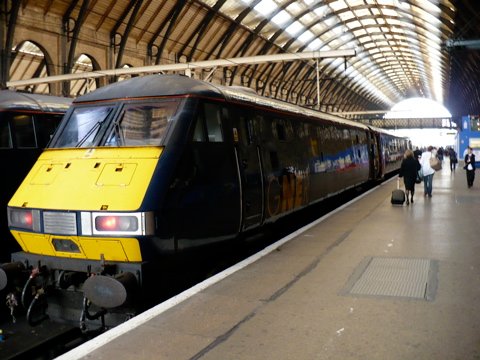
The last photo I ever took in London: the 0830 GNER service from Kings Cross to York …
 This work is licensed under a Creative Commons Attribution-NonCommercial-NoDerivatives 4.0 International License.
Permissions beyond the scope of this license may be available at http://airminded.org/copyright/.
This work is licensed under a Creative Commons Attribution-NonCommercial-NoDerivatives 4.0 International License.
Permissions beyond the scope of this license may be available at http://airminded.org/copyright/.

I never knew Aldwych Post Office had such an airminded connection! It’s just up the road from where I work. Frankly, I avoid it like the plague because of the queues (unavoidable last week, however, much to my chagrin…).
The Queen’s Tower at Imperial has a (very tenuous!) Wellsian airminded connection, in that it is the only remaining part of the large complex of buildings that formed the old Imperial Institute which was next door to the Normal School of Science, later the Royal College of Science (and later still to form the nucleus of Imperial College), which is where HG Wells studied. Later, in Wells’s short story ‘The Argonauts of the Air’, his aviation pioneer Monson makes the first heavier-than-air flight, only to lose control of his machine over the Imperial Institute whilst trying to avoid the towers and crash in flames onto the Royal College of Science roof…
H G really had a fondness for smashing up places he’d lived in or worked, at least in his fiction.
Colindale may look dodgy, but in fact it’s the best-policed bit of London outside Whitehall. Peel House, the Met Police training centre in Hendon, is down the road, so the streets are full of eager young coppers practicing walking.
The coffee room at Colindale, though, _is_ dodgy.
Roger:
Well, the next time you have to stand in line there you can amuse yourself by pondering its history! Should keep you amused for at least 20 seconds …
Chris:
That may be as is, but I never saw any coppers south of the tube, where the library is. I reckon the old bill are too scared to interfere with rowdy BL patrons messing about with shopping trolleys!
More seriously, I’m reading Graves & Hodges’ The Long Week-end at the moment and they talk a bit about Trenchard’s time as head of the Met. In particular they say he tried to introduce a sort-of class element into the force by setting up the training college at Hendon, to attract middle-class and above types, whereas the Met had mainly been lower and lower-middle class before. They don’t quite say so, but it sounds like a knock-off of Cranwell (which Trenchard founded, of course). Is there anything too that? I’ve often wondered what RAF influences or ideas the Met may have picked up via Trenchard. (I think aerial traffic surveillance may have been one — at least it was tried in London in the mid-1930s, but not sure if that was police or not.)
Hi Brett. The answer is yes. I think that Trenchard drew on 3 air things in his time at the Met:
1) Central control of police cars through wireless, which was a straight lift from the London Air Defence Area. Real Soon Now I will have an article in _Technology and Culture_ about this, just as soon as I re-write it totally…
2) The Hendon scheme to create an officer class for the police. This was intended to create an elite who’d populate the higher ranks, not to cover every supervisory rank. Obviously Cranwell. Lots of people have written about this already – refs on request.
3) A scheme whereby police officers could join as constables for ten years, rather than signing up for the traditional twenty-five. I think that this, as much as the Hendon scheme, derived from military practice.
In addition to all this, T put a lot of effort into breaking the power of the Federation, notably by persuading the great and the good to fill up Commissioner’s FUnd, which was used to establish and finance a monopoly of all police recreational facilities.
Very interesting, thanks. I suppose he did perforce have a lot of experience as an institution builder. Do let us know when the paper comes out!
RE: The Queen’s Tower at Imperial College, the last remnant of the old Imperial Institute.
A monument to state vandalism – London’s “Ground Zero” in my humble opinion as one who sat many an examination for London University in the old building.
John Vetterlein
Astronomer by trade!
Astronomer by training here! I’m surprised they kept any of it, actually — the 1950s don’t seem to have been a great era as far as preserving the past goes.
I have lived in Melbourne for all but 6 years of my life, and know the Shrine well, but I had never before heard the name Jagger connected to the Driver and Wipers sculpture.
What is even more noteworthy is that the two male sculptures at the Shrine were recast directly from the British figures!!
I came to Jagger via a very racy 1930 low relief work that is as far away (in content) from the war memorials as day is from night. I will create a link to your post, many thanks.
Hels
Art and Architecture, mainly
Interesting post and blog, Hels — thanks!