

[Cross-posted at Revise and Dissent.]
Photographs of actual combat in the First World War are exceedingly rare, in the air as well as on the ground. Both of these are purportedly of Zeppelins flying over Britain. Are they fake or not? My answers are below.

`The low down thing that plays the low down game’. Source: British postcard, Zeppelin im Krieg.
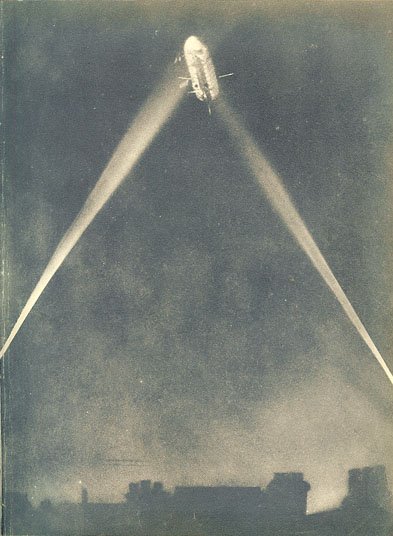
‘Over London’s roofs. London’s defences against Zeppelin raids were never adequate. Searchlights sometimes succeeded in spotting the raiders, as in the actual photograph by an amateur shown in the impression on the opposite page, but the anti-aircraft guns never secured a direct hit. Zeppelin raiders were only checked and finally defeated by aeroplane attack’. Source: Hamilton Fyfe, “Early Zeppelin nights of terror”, in John Hammerton, ed., War in the Air: Aerial Wonders of our Time (London: Amalgamated Press, n.d. [ca. 1935]), 17.
OK, I think the first one is a pretty obvious fake, for a number of reasons. Firstly, from the shape of the hull and the arrangement of the gondolas, it’s clearly a pre-war model Zeppelin, and these took part in only the very earliest raids. Secondly, it’s hanging down very low over a town or city, hardly standard operating procedure, as it would have been very vulnerable to anti-aircraft fire. Finally, it seems unlikely that a night-time photograh could be this clear, given the technology available, and there seems to be too much light on the Zeppelin. It would need a longish exposure time to gather up the required number of photons, but then it would be blurrier. My guess is that it’s based on a retouched pre-war photograph of a Zeppelin.
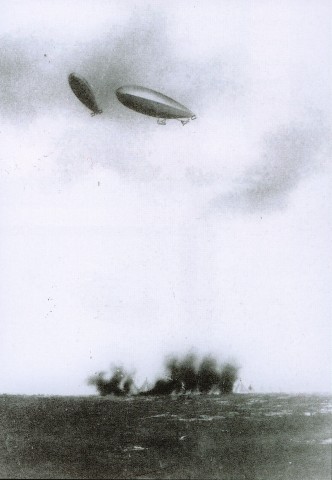
I was initially more impressed by the second photo — it seems more dynamic, less staged than the postcard. But upon reflection, I think it’s a fake too. Like the first one, it’s a bit too clear and bright for a night-time photo. Also, the airship looks too short and stubby for a Zeppelin. And finally, have a look at the searchlight beams — they are very narrow and based on their low rate of divergence, the sources would have to be in mid-air, just off the edges of the photo. I guess the British could have mounted searchlights on tall towers — but they didn’t! So, my conclusion is that this is also a doctored photograph, possibly of a small British airship (though I haven’t been able to find a good candidate).
Such photographs make sense as propaganda, official or unofficial (the first image above is even sanctioned by the ‘Official Press Bureau’). Zeppelins were much discussed, sometimes heard, but very rarely seen, so people would have been curious to see what it was they had been imagining. This would have helped dispel some of the menace of the Zeppelin, which was based on its seeming ability to come and go as it pleased without being detected; showing them caught in the searchlights would have suggested their vulnerability. Other examples of faked air combat photos exist — Rosebud has a number of them (including, I notice, the Zeppelin postcard above). This one is my favourite:
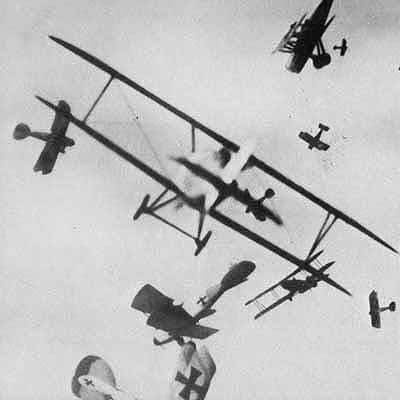
It’s very well done, but not very plausible. Who is going to whip out their Box Brownie in the middle of a dogfight and manage to snap off such a well-focused shot? Even today, many of us have trouble taking non-blurry images with all the advantages of digital photography. No doubt the above image was created to satisfy public demand for images of aerial knights jousting in the skies. In modern parlance, it was photoshopped.
Which leads me to another problem with the two airship photos above: I don’t know where they originally came from. The first one I found on the web, the second from a mid-1930s magazine, so in neither case do I have contemporary sources. They could even be post-war fakes, for all I know. Or in the case of the first one, a modern fake. I doubt that, in this case — it’s very well done, and of a very obscure subject, if so. But the point is that modern technology makes it much easier to fake a photo (though it can make it easier to detect trickery, as well). The easier something is to do, the more likely it is that people will do it. And so we get images like this one (from here):
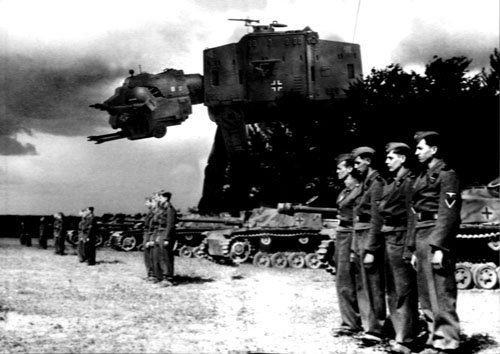
Ok, so this presumably was never meant to fool anyone (!), and it’s still not entirely convincing, but it shows what can be done. There are plenty of other examples around, some for fun, some perhaps not. Of course, the best way to guard against being taken in by such images is to check their provenance and their context, the same with any piece of historical evidence. Can the original source for the image be traced? Does the content fit into what is known about the period? If not, then no weight can be placed upon it. This will not exactly be a revelation to historians, but it’s surprising how many people still believe that images speak for themselves.
 This work is licensed under a Creative Commons Attribution-NonCommercial-NoDerivatives 4.0 International License.
Permissions beyond the scope of this license may be available at http://airminded.org/copyright/.
This work is licensed under a Creative Commons Attribution-NonCommercial-NoDerivatives 4.0 International License.
Permissions beyond the scope of this license may be available at http://airminded.org/copyright/.


Great post Brett: would be interesting to look at all Hammerton images and work on his (or rather his team’s) attitude to retouching and faking. I’ve got a set of his Popular History of the War, and a number of the images look, to modern eyes, very clearly re-drawn or scratched out. Fascinating as a topic on visualising war/or representing it, for whatever means.
Yes, I often notice photographs that have obviously been retouched or altered in some way. I wonder if it was obvious to people at the time? Or are we today just more experienced in interpreting photos? I incline to the latter view, given the example of the Cottingley fairies …
good thing i typed baba in google ,found this gem
http://www.cicap.org/root/podcast.php
and who is in his weird linklist.
Hoppa
look what popped up , airminded. cute blog , nice links , don’t call 911 , i’m gonna rob some links, and yes this gun is fake.
Much too low. The Zeppelins came in at 15,000 feet; later in the war it was much higher. With that first photo, the beams almost look like crayon, although it could have been a pre-war publicity snap. With the second one, there are strange things like masts sticking out from the sides, which I guess were used for flags, one of which is visible on the left. So, again, a peacetime photo redoctored.
I think the artillery couldn’t touch them because the shells went straight through. There were 18 ballonets inside the bigger ones which could take a lot of damage.
Once they put tracer into the ammunition belts on the fighters it was all over, red rover and there was no defence but height. Eventually the Germans didnt even put guns on the airships.
Those planes are a bunch of models dangling together in a studio. Although the fighters got pretty close to hit each other, I imagine any manoevering would have created quite large spaces between the dogfighting pairs.
Yes, the lowness is very suspicious; however there are a few accounts of Zeppelins coming down low, eg below cloud cover to check where they were. But it was a very dangerous thing to do indeed, and highly unusual.
I think you’re right about them being pre-war pictures; I did find some pre-war photos of a Zeppelin which looked very similar to the top photo, except that they were taken during the day. (And of course the fact that they are night photos is the biggest problem to begin with …) My guess is that the fake is a retouched negative of a daylight photo.
On the second one, the projections out the side are very strange. Maybe for flags, as you say — perhaps for communicating with troops on the ground? I don’t know if this was standard procedure or not.
Very good. Agree with David Tiley on Zeppelins. Given their surprising airspeed and rate of climb, I wonder if there were more low altitude excursions than just for navigation checks ….. perhaps even a precursoer of the tree-top run-in for a helicopter ground attack.
Don’t underestimate the ingenuity of early 20th Century photographers though; some amazing photos were taken with old bellows cameras.
The “dogfight photograph” is from the book “Death in the Air” by Anon., though it was later “revealed” to be the work of “Mrs Cockburn-Lange”, widow of an RFC pilot. It was actually the work of Wesley Archer, an American who had flown in the RFC. The National Air and Space Museum has a collection of his photographs, including pictures of the models he used in the dogfight shots. Peter Grosz and Karl Schneide wrote an article for Air and Space Magazine about the pictures back in 1985. I remember being unconvinced by the photo when I ran across it when I was 12 years old.
Thanks Allan! I found a listing of the photos and a bit more info on Archer here.
My mother described one that came out of the clouds to bomb a pub and bakers shop in Old Ford in the first world war. She was 18 years old at this time.
Thanks Godfrey. I wonder when that raid was … maybe the one of 23 September 1916?
Pingback: Airminded · Trouble at Millwall
The dogfight picture appears, either in colour or colourised, on the front cover of Jane’s Fighting Aircraft of World War 1 (Studio Editions, 1993). There’s a similar photo on the back cover and the jacket describes them as:
Photographs of air fighting in the First World WAr. First printed in the Illustrated London News, October 1932. Reproduced by kind permission of the Illustrated London News.
Thanks, Rik — I have that edition of Jane’s, actually. Yes, the photos were published in Illustrated London News in October 1932, but even at the time there were doubts about their authenticity. An article from Time (16 January 1933) summarises questions raised by C. G. Grey in The Aeroplane. Interesting that it took until the 1980s to finally debunk them.
Until I actually bothered to check the dust jacket, I’d assumed the picture had been produced just for the Janes book – I really had no idea that anyone had claimed they were genuine.
On the other hand, photos in interwar magazines sometimes to look fairly unconvincing.
Interesting that the Time article describes people assuming the pictures generated by superimposing real negatives of real planes, rather than models.
I reckon it’s pretty good for the time, actually, it’s just implausible. I don’t think people at the time ‘read’ photos in the same way as we do now, and things which seem like obvious fakes today seem to have been accepted without comment back then.
Pingback: Airminded · Am I fake or not? — II
Pingback: Airminded · Finding the target
Pingback: Airminded · London 1914-17 and London 1917-18
Pingback: At At | AllGraphicsOnline.com
Pingback: Airminded · Am I fake or not? — III
The dogfight photos are from a book that an uncle of mine had. It fascinated me when I was a kid (c. late 1950s) but I can no longer remember the title or author (and nor any longer do I find his tale credible!). The writer claimed to have been a Great War pilot who fixed a camera to his aircraft which he then triggered in action and essentially hoped for the best. It wasn’t a case of composing a shot. There were several similar shots allegedly showing the sheer confusion of air fighting including a mid-air collision.
That sounds like it might have been the original publication, which Allan mentions above: Anonymous, Death in the Air: The War Diary and Photographs of a Flying Corps Pilot (London: Heinemann, 1933). The link about the Cockburn-Lange hoax I provided a few years ago is dead now, but here’s a new one; additionally the NASM has a collection of related material.
Pingback: Am I fake or not? — IV | Airminded