

OK, I promise to stop doing that. This time, the answer seems to be: probably …
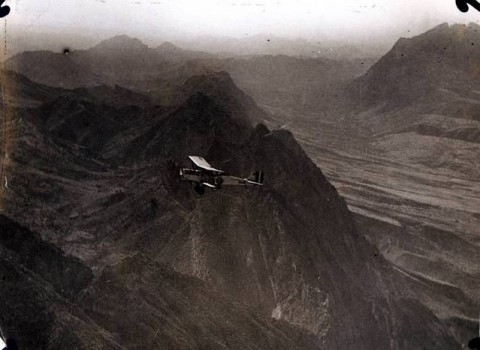
Coming via Charlie’s Diary is a New Yorker article by Seymour Hersh on the new US exit strategy in Iraq, which reports that “A key element of the drawdown plans, not mentioned in the President’s public statements, is that the departing American troops will be replaced by American airpower”. As Charlie Stross notes, this brings to mind British air control policies, in which bombers were used to pacify and control Iraq in the 1920s (which is what L.E.O. Charlton was criticising). So is this the same thing, but with F/A-18s instead of DH.9s? Could be, because as James Corum has argued, in fact air control did not succeed by airpower alone. It was more like a combined operation, with British Army units often playing a large role. Similarly, the US Air Force won’t be working alone, but in conjunction with Iraqi ground forces. Now, Corum also argues that air control was not as effective as is often claimed – for example, rebellious tribes learned to adapt to this strange new aerial weapon by developing air raid precautions: slit trenches and early warning systems. Maybe modern insurgents can adapt too. On the other hand, the modern air weapon is far more precise and powerful than anything available back then.
Update: please ignore the footnote: as pointed out in the comments, Hersh’s figure is an order of magnitude too large.
 This work is licensed under a Creative Commons Attribution-NonCommercial-NoDerivatives 4.0 International License.
Permissions beyond the scope of this license may be available at http://airminded.org/copyright/.
This work is licensed under a Creative Commons Attribution-NonCommercial-NoDerivatives 4.0 International License.
Permissions beyond the scope of this license may be available at http://airminded.org/copyright/.

500,000 tons? That looks like a decimal point error to me – I did some back of the envelope calculations about this kind of thing when investigating a similar error in Sven Lindquist’s _History of Bombing_ which he’d repeated from somewhere else. This one referred to the weight of bombs a squadron of Lincolns could drop on (or about) the Mau Mau in 3 years. Round-the clock ops can only just get you to 50,000t, which was Lindquist’s duff figure.
1000 tons a day? Nah. A brief Clancy moment informs me that the F/A18 can carry 17,000lb, AKA 8.5 tons. Fox news tells me that there are 4 squadrons in an MAW (says 3 attack and 1 fighter, but we’ll assume the fighter’s been replaced by an attack), and FAS tells me that there are up to 18 planes in an attack squadron. 72 * 8.5 = 612 tons. That works out at more than one and a half sorties a day, every day. Nah. Sy’s got this one wrong.
Hmm, I didn’t think to question those figures. I don’t think they are operationally impossible though, especially against minimal air defences – but I will concede it seems extremely unlikely when you think about it. How can there be so many targets? For just one MAW? Only about 88,000 tons were dropped during the entire 1991 war. It is hard to believe that the current air war is more intense than that.
But it’s not entirely Hersh’s fault if he’s wrong, I did try to find the USMC press release he gets his numbers from, and there’s a copy here which has the 500,000 tons figure. However, the original appears to have been pulled from the USMC website (Google has it cached, for the moment) – maybe because the numbers were wrong …
Operationally impossible? I think that *rate* might be achievable during a surge period of intense operations, for example during the invasion of Iraq, but with multiple (and usually long, being CAS missions involving loitering) combat missions a day one wears out aircraft and men quickly.
I certainly don’t see them keeping it up for three years without a BoB-like turnover of personnel. Even Chris’s figures look high to me: they assume a serviceability rate of 100%, which is impossible in practice and probably unachievable even in a pinch. Plugging in 80% average serviceability, you get 493 tons/sortie for the full wing, requiring 1014.19 wing sorties to deliver 500,000 tons..or 1.81 wing sorties a day.
Now, how many days during that period are likely to have been lost to the weather, and how many sorties end without dropping ordnance? As most of the invasion period F/A18 missions and all the subsequent ones were CAS/cab rank ones in support of ground forces, there will have been a nontrivial number of missions where the grunts didn’t call for air support or the target could not be identified well enough to drop anything near friendly forces, to say nothing of missions aborted for technical or deconfliction reasons.
What would be a reasonable value for these? It’s a hot flat desert, so the main weather threat is a sandstorm. Say one day in ten is weather-affected. That cuts the time period by 56 – so 1014.19/504=2.01 wing sorties/operational day. If we attribute 5% dropoffs to missions aborted in-flight, which is probably conservative, that would be another 57 sorties required, so 1071.19/504=2.13 wing sorties over-target/operational day, and if we then reckon that 10% of missions that arrived over-target didn’t drop anything (which is definitely conservative), we get a figure of 1178.1 sorties required to deliver the bombs/504 operational days=2.34 wing sorties/day, which implies a BoB-like operational intensity sustained throughout a year.
Which, I think we can safely say, is bollocks.
Not only that, but I picked up the wrong figure for squadron size from globalsecurity – it’s 12 planes for all but AV8B squadrons. Sorry. On the other hand, a Marine Air Wing is a formation, not a unit, so it might have more attack squadrons in it than usual.
The USN bit of Globalsecurity claims that their carrier air wings can sustain about 1.5 sorties per day (many of which will be defensive patrols) for ‘sustained operations’. But they also claim that they only aim to keep up 2 sorties a day for 3-5 days. So I think that we can safely discount their definition of ‘sustained’.
Looks like the USMC employ (or employed) at least one press officer who doesn’t know enough about their employer’s organisation to sniff a obviously bullshit press release. It wouldn’t be the first organisation to do that.
No, the worrying thing is Hersh buying it. He’s supposed to know about numbers and facts and stuff.
Forgetting the Clancy-isms for a moment, couldn’t we have worked out that this was a _bit_ implausible by following through your point that: ‘that’s roughly as much as the Allies dropped in Europe in 1945.’ Plenty of Iraq’s still wrecked, I know, but given that munitions have got more effective, would there be anything left if they’d dropped that much? Does/did Iraq actually have enough targets to receive that level of bombardment? Not that not having enemy targets would stop the US flyboys doing their thang, necessarily. After all, there’d have been plenty of British squaddies to bomb…
Modern air weapon more precise and powerful? Hmm. I notice how powerfully it solved the military problem of killing OBL.
Ouch. Mea culpa! I surrender. I admit I didn’t think about whether those numbers were plausible (clearly a career in USMC public relations beckons!) In my defence, all I can say is that in my research I am generally more interested in claims about the effectiveness of airpower, than the reality, though that shouldn’t mean checking my brain at the door …
Alex: probably I meant “not physically impossible” rather than “operationally”. Yes, those numbers are too high for a 19-month campaign. But they don’t violate the laws of physics either. In a completely hypothetical and unrealistic situation, if enough resources were thrown at 3rd MAW (eg rotating in fresh personnel and aircraft from other units) then such a rate might be sustainable, particularly given the lack of opposition (one rather large difference between Iraq and the Battle of Britain, I’d say). I concede that this is impossible in practice (and even the surge rate from the opening weeks of the war wasn’t as high, judging by this).
Dan: yes, for me the lack of targets is (or should have been) the giveaway, as I did already point out :) They would have been bombing the craters left over from previous strikes … About OBL: that is perfectly true, but it partly goes back to the question of independent airpower vs combined arms (which was Corum’s point). For one thing, you’d want to know what is (and isn’t) a target, so good intelligence is needed, and boots on the ground helps with that. Israel has demonstrated (though perhaps not perfected) this kind of operation against individuals in the Palestinian territories: it clearly can be done. This leads to the question: does the US have good intelligence? Which I think can be answered by another question: is OBL still at large?
Hmm. Does it matter whether or not you can use airpower to kill the leader of an insurgency/terrorist organisation? Can you use it to change the political/domestic context in which that insurgency is taking place? I think you probably can now, but only by bombing the living snot out of everything in a manner which is politically and humanly unacceptable. Israelis – great at fighting insurgents/gallant freedom fighters, crap at ending said insurgency/gallant war for freedom or whatever.
Oh, and no need to say ‘ouch’. I was taking the mick out of the Clancy-isms (partly out of jealousy) rather than flaming yer.
No, I don’t think killing off the leaders would work here (or in most such cases), but I was thinking of strikes on insurgent cells and suchlike as well. I don’t see that a massive and indiscriminate bombing campaign would work, unless it literally wiped Iraq off the map (which seems somewhat counterproductive). Otherwise it would simply increase support for the insurgents. That might not be the case were precision air strikes employed, in conjunction with effective ground forces, if intelligence is good and collateral damage minimised (ie no bombing wedding celebrations). That offers the best chance of dealing with the insurgency without inflaming hatred. At least that’s what I infer from what I understand of the British experience in the 1920s. But hell, I’m no strategist …